AI Search
The New AI Search KPI: Are Business Mentions Becoming as Important as Organic Clicks?
AI brand mentions, recommendations and citations add a new visibility layer to SEO reporting—but they are not interchangeable with organic clicks, leads or revenue.
By Muhammed Lisan A · · Updated
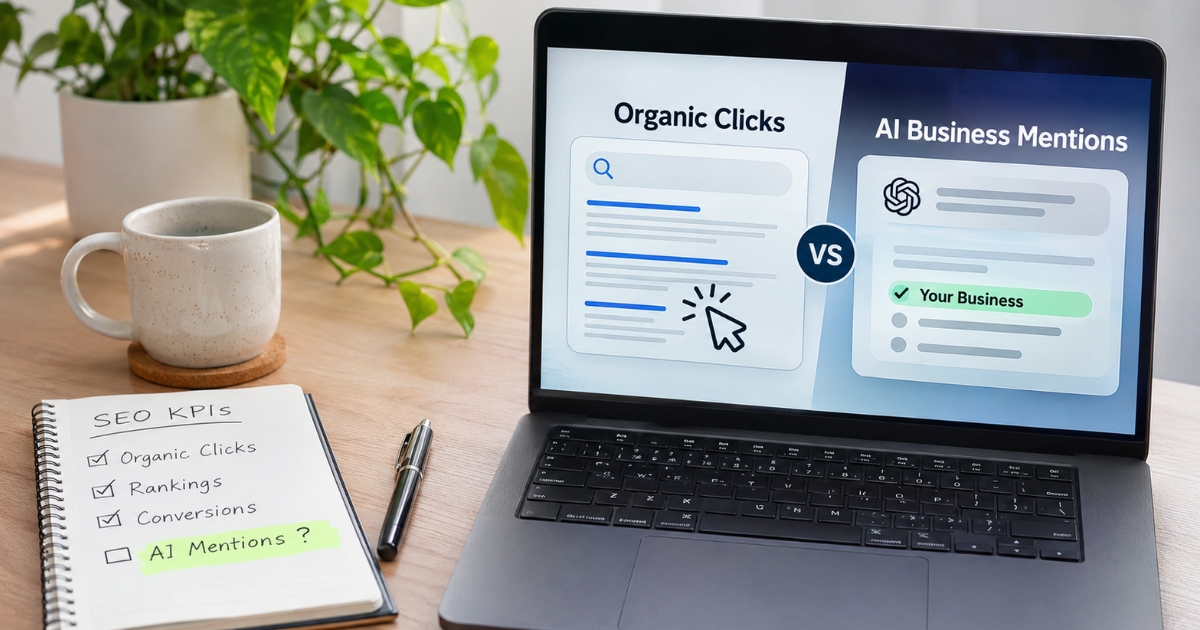
The Click Is No Longer the Only Signal
A potential customer asks an AI assistant to recommend digital marketing agencies. The assistant supplies a shortlist, describes services and sometimes links to sources. Some businesses appear; others are absent. The customer may make an initial decision without visiting a single website. For the agencies that appeared, traditional analytics might record nothing.
How should businesses measure visibility when an AI assistant mentions or recommends them without producing a website click? Organic clicks remain valuable because they record an observable action. AI mentions capture a different event: a brand appearing in a generated response. The case for tracking them depends on consistency, context and demonstrated business outcomes—not mention counts alone.
Why Traditional SEO Metrics Still Matter
Rankings show search positioning; impressions record eligible search appearances; clicks and sessions describe user engagement; conversions connect visits to outcomes; backlinks and referring domains describe the link profile. These metrics remain essential. Their gap is that they do not fully observe customers who discover businesses through AI answers and never click.
Google announced dedicated generative AI performance reporting in Search Console in June 2026. Microsoft Bing Webmaster Tools documents AI citation activity, cited pages and grounding queries. Neither is a universal cross-platform record of business recommendations.
Five Different Events Behind AI Visibility
| Term | Meaning |
|---|---|
| Brand mention | A company name appears in an AI answer, whether positively, neutrally or negatively. |
| AI citation | The answer references a supporting source, which may be the company site or a third party. |
| AI recommendation | The company is actively suggested as an option. |
| AI referral visit | A user clicks from an identifiable AI source to the website. |
| AI-assisted conversion | A conversion follows an AI interaction, whether directly measured or only self-reported. |
A neutral reference to an agency, a recommendation to hire that agency and a citation of its blog are not interchangeable. A business can be recommended without its own website being cited; its website can also be cited without the business being recommended. OpenAI, Perplexity and Anthropic document source-linked answers, but citations alone do not prove endorsement.
Why AI Business Mentions Could Matter
AI recommendation prompts may contribute to shortlist formation. A brand appearing in relevant answers may become one option a customer investigates; competitors repeatedly appearing while the target brand is absent can reveal a discovery gap. Tracking answer wording can also expose inaccurate descriptions, outdated services and geographic mismatches.
There are serious limits. A generated mention does not establish that a real user saw, trusted or acted on the answer. Hundreds of low-intent informational mentions may be less commercially useful than a few relevant buying-stage recommendations. Branded search growth following a visibility change may reflect advertising, seasonality or publicity instead. Correlation is not causation.
Ahrefs reported in February 2026 that AI Overview presence correlated with a 58% lower average CTR for top-ranking pages in a study of 300,000 keywords; this was an observational comparison, not proof of causality for each click. Similarweb reported estimated AI referral traffic in 2026, but referrals exclude people who see an AI answer without clicking.
Organic Clicks vs. AI Mentions
| Measurement | Organic clicks | AI business mentions |
|---|---|---|
| Event | User clicks a search result | Brand appears in generated answer |
| Traffic | Observable search click | Not implied |
| Attribution | Established but imperfect | Often incomplete |
| Conversion link | Can be linked to sessions | Requires separate evidence |
| Primary limitation | Misses no-click discovery | Does not prove actual audience exposure |
A company with 500 organic clicks and appearances in 50 tested AI answers has not earned 550 equivalent interactions. The units are different. Many AI monitoring tools observe responses to sampled prompts rather than real audience exposures.
Eight Practical AI Visibility Metrics
Mention rate. Suggested formula: responses mentioning the brand / eligible tested responses × 100. Count each brand at most once per response. Limitation: heavily influenced by prompt selection and platform settings.
Recommendation rate. Responses actively recommending the brand / eligible recommendation responses × 100. Define recommendation criteria in advance; ambiguous language requires review.
Citation rate. Responses citing the company domain / eligible responses × 100. Record third-party citations separately. A citation does not prove recommendation or traffic.
Share of AI voice. Brand-response appearances / total appearances of all tracked brands × 100, with each brand counted once per response. This is a proposed unweighted method, not a universal standard. Proprietary vendor scores may use different denominators or impression estimates.
Platform coverage. Platforms with at least one observed brand mention / platforms tested × 100. Presence across platforms does not establish equal reach.
AI referral traffic. Use GA4 acquisition and referral data, and campaign parameters where available, to count identifiable AI-origin visits. Missing referrers and no-click interactions remain unobserved.
AI-assisted conversions. Track directly attributable AI referrals, self-reported discovery and inferred involvement separately. Do not merge uncertain attribution with confirmed conversion counts.
Mention context. Code recommendation status, sentiment, factual accuracy, industry relevance and geographic relevance. Human review is important because automated sentiment can misclassify nuanced comparisons.
All formulas above are suggested measurement conventions, not official industry standards. Preserve raw answers, prompts, timestamps and the calculation rules.
A Repeatable AI Visibility Tracking Experiment
Consider a hypothetical digital marketing agency. Create 30 prompts: six informational, eight commercial, eight comparison and eight recommendation questions. Include relevant geographic and industry qualifiers, but avoid naming the agency in every prompt. Choose three or four relevant AI experiences and a fixed competitor set.
Record the platform, model or mode where available, location, account state, web-search configuration, prompt and complete answer. For each response, identify brand mentions, recommendations, company-domain citations, third-party sources, competitors and factual accuracy.
| Date | Platform | Prompt | Mention? | Recommended? | Cited? | Competitors / context |
|---|---|---|---|---|---|---|
| Test day | ChatGPT | Recommend SEO agencies for SaaS | Yes | Yes | No | Agency B; positive |
| Test day | Gemini | Compare technical SEO agencies | No | No | No | Agency B, C; absent |
| Test day | Perplexity | B2B lead-generation agencies | Yes | No | Yes | Agency C; neutral |
Illustrative entries only. No real experiment or outcomes are claimed. Repeat at consistent intervals, preferably with multiple runs per prompt. Thirty prompts tested three times across three platforms yield 270 response observations. Preserve repeats individually; do not equate observations with distinct users.
AI outputs vary with wording, time, model updates, personalization, retrieval and location. Standardize conditions, use fresh conversations and keep a separate exploratory prompt set. If visibility improves after a content update, describe it as an association unless stronger experimental controls support causal inference.
What Current Tools Can Measure
| Tool | Relevant capabilities and limitations |
|---|---|
| Google Search Console | First-party Google search and generative AI performance data; not universal cross-platform brand recommendations. |
| GA4 | Identifiable referral sessions and website conversions; not unclicked AI mentions. |
| Bing Webmaster Tools | Citation trends, cited pages and grounding queries; citations are not clicks or rankings. |
| Ahrefs Brand Radar | Mentions, citations, competitor comparisons and share-of-voice measures; depends on sampled responses and estimates. |
| Semrush AI Visibility | Mention and citation analyses, competitor benchmarks and proprietary visibility scores; not direct user-exposure measurement. |
Profound, Otterly.AI and Peec AI are additional vendors to evaluate, but precise current feature coverage, history, exports and platform availability should be checked in live vendor documentation before purchase. Ask every provider how prompts are sampled, what qualifies as a recommendation, how frequently answers are collected and whether raw responses are exportable.
Should AI Mentions Enter the SEO Dashboard?
For businesses where AI-assisted discovery is relevant, yes—as a diagnostic visibility layer rather than a replacement for search or commercial KPIs. Separate three layers: (1) traditional SEO: impressions, rankings, clicks and organic conversions; (2) AI visibility: mentions, recommendations, citations, share of voice and platform coverage; (3) outcomes: qualified leads, attributable AI referrals, branded search demand, assisted conversions and revenue.
Do not count an AI mention as a lead or add mention counts to organic clicks. If a customer later searches the brand on Google, the click remains organic unless there is evidence of the earlier AI interaction. A defensible report might say: “Recommendation rate rose from 20% to 30% in our fixed commercial prompt sample; clicks and qualified leads remained stable.” This is a hypothetical illustration, not measured performance.
Recommendations by Business Model
SEO agencies: Track service and location recommendations, competing agencies and qualified inbound enquiries. SaaS: Track use-case and alternative-product prompts alongside trials, demos and product-qualified leads. Local businesses: Monitor service-area accuracy and relevant local recommendations; use calls and bookings only with appropriate attribution evidence.
Ecommerce: Test category and product-comparison prompts; track product details, merchant links, identifiable visits and purchases. ChatGPT shopping features can surface product options, but visibility does not guarantee sales. B2B services: Focus on specialized vendor-selection prompts, CRM evidence, proposal requests and longer sales cycles.
Original Research Questions Worth Testing
Do brands mentioned more frequently in AI answers subsequently receive more branded searches? Are recommendations more valuable than neutral mentions? Do different platforms select the same businesses for identical prompts? How often are brands recommended without their own domains being cited? Can strong organic rankings coexist with weak AI visibility? How much does a small change in prompt wording alter recommendations?
These are research questions, not established findings. Each requires a documented sample, consistent conditions and careful handling of confounders.
Proposed Experiment: Mentions and Branded Demand
Status: proposed, not conducted. For a real service business, establish a repeated 30-prompt baseline across relevant platforms. Collect branded Search Console impressions and clicks, GA4 identifiable AI referrals, qualified CRM enquiries and a log of marketing activity. Implement a documented information-quality intervention, such as clarifying service pages and correcting inconsistent business descriptions. Continue testing the identical prompt set afterward.
Use recommendation rate as the primary outcome; branded searches and leads are secondary. Account for seasonality, other campaigns, platform changes and lag. Improvements across all measures would warrant investigation, not automatic causal attribution. Visibility rising without leads would still be a valid—and commercially important—finding.
Conclusion: Measure Visibility, Not Just Visits
Organic clicks remain valuable because they represent identifiable user actions and can connect to conversions. AI-generated answers create another dimension of discovery: a company may be mentioned, recommended or cited without an immediate visit. Ignoring that dimension can leave a competitive visibility gap, but treating every mention as a success is equally misleading.
A mention is not necessarily a recommendation. A citation is not an endorsement. A recommendation is not a lead. Visibility is not revenue. The strongest SEO and GEO reporting combines stable AI prompt tests, conventional search metrics and verified business outcomes. AI mentions can become a useful KPI when the definitions, sampling and commercial limitations remain visible.
References
- Google Search Central, Generative AI Performance Reports (June 3, 2026)
- Bing Webmaster Tools, AI Performance documentation (undated)
- OpenAI, ChatGPT Search help documentation
- Perplexity, official platform information
- Anthropic, Web Search announcement (March 20, 2025)
- Ahrefs, AI Overviews Reduce Clicks (February 4, 2026)
- Similarweb, AI Referral Traffic by Industry (September 3, 2026)
- Ahrefs, AI Visibility Metrics documentation
- Semrush, AI Visibility Data Methodology
- OpenAI, ChatGPT shopping documentation

Written by Muhammed Lisan A
SEO & GEO Specialist in Kerala
Muhammed Lisan A publishes practical, evidence-based research on technical SEO, crawlability, and generative engine optimization (GEO). Based in Kerala, he focuses on how modern search engines and AI answer systems discover, index, and cite content.