Content Strategy
Digital PR vs Traditional Link Building: Which Creates More Long-Term Value?
Compare Digital PR and traditional link building through editorial relevance, audience fit, sustainable references and measurable business outcomes—not backlink counts alone.
By Muhammed Lisan A · · Updated
Introduction: Are We Still Measuring Link Building the Wrong Way?
Imagine two SaaS companies trying to improve their online authority. Company A secures relevant industry links through guest contributions, resource outreach and link reclamation. Company B publishes an original research report and earns editorial coverage through journalist outreach. Both acquire backlinks, but their results may differ substantially. Company A may attract highly qualified buyers at relatively low cost; Company B may gain broader recognition, referral visits and lasting relationships. Neither automatically wins.
The central mistake is treating backlink counts as a complete performance metric. A backlink is an acquired asset; its long-term value depends on editorial relevance, audience fit, sustainability, referral engagement and measurable business outcomes.
What Is Traditional Link Building?
Traditional link building seeks relevant external links through targeted outreach, useful contributions, resource promotion and reclamation. It is not inherently spammy. Legitimacy depends on editorial value, reader benefit, acquisition practices and compliance with Google Search policies.
| Method | Potential value and main caution |
|---|---|
| Guest contributions | Can reach specialist audiences; scaled articles with manipulative anchor text are risky. |
| Broken link building | Offers a genuinely suitable replacement for a broken resource; weak substitutes provide little benefit. |
| Resource page outreach | Places helpful assets in curated lists; avoid indiscriminate directory-style placements. |
| Link reclamation | Restores references lost to URL changes or page errors; publishers may intentionally remove links. |
| Competitor backlink analysis | Reveals relevant publications and gaps; do not copy irrelevant competitor links. |
| Niche edits | May create useful context if editorially justified; paid insertions intended to pass ranking credit are risky. |
| Relevant directories | Support discovery and local citations; avoid mass low-quality submissions. |
| Relationship outreach | Can build recurring specialist relationships; requires sustained contribution. |
| Unlinked mention outreach | May make existing citations navigable; publishers are free to decline. |
Google warns against buying or selling links for ranking purposes, excessive link exchanges, automated link creation and large-scale guest-post campaigns intended to manipulate search rankings. An expert contribution written to inform a relevant audience is fundamentally different from a generic article distributed primarily for keyword-rich backlinks.
What Is Digital PR?
Digital PR earns online attention through newsworthy stories, original research, data journalism, expert commentary, reactive pitching, thought leadership and creative campaigns. It starts with information worth publishing, rather than a predetermined list of link targets. Journalists and editors independently decide whether and how to cover the story.
Common formats include proprietary-data reports, transparently designed industry surveys, public-data analysis, expert reactions to emerging news, research-led visuals and genuinely newsworthy announcements. Press-release syndication is not equivalent to independent editorial coverage.
Digital PR can produce editorial backlinks, unlinked brand mentions, referral traffic, brand exposure and partnership opportunities. These are separate outcomes: a media mention does not automatically create a backlink, and a backlink does not automatically create rankings or sales. Muck Rack’s 2026 State of Journalism survey provides evidence that PR pitches remain part of journalists’ workflows, but it is not a universal campaign success benchmark.
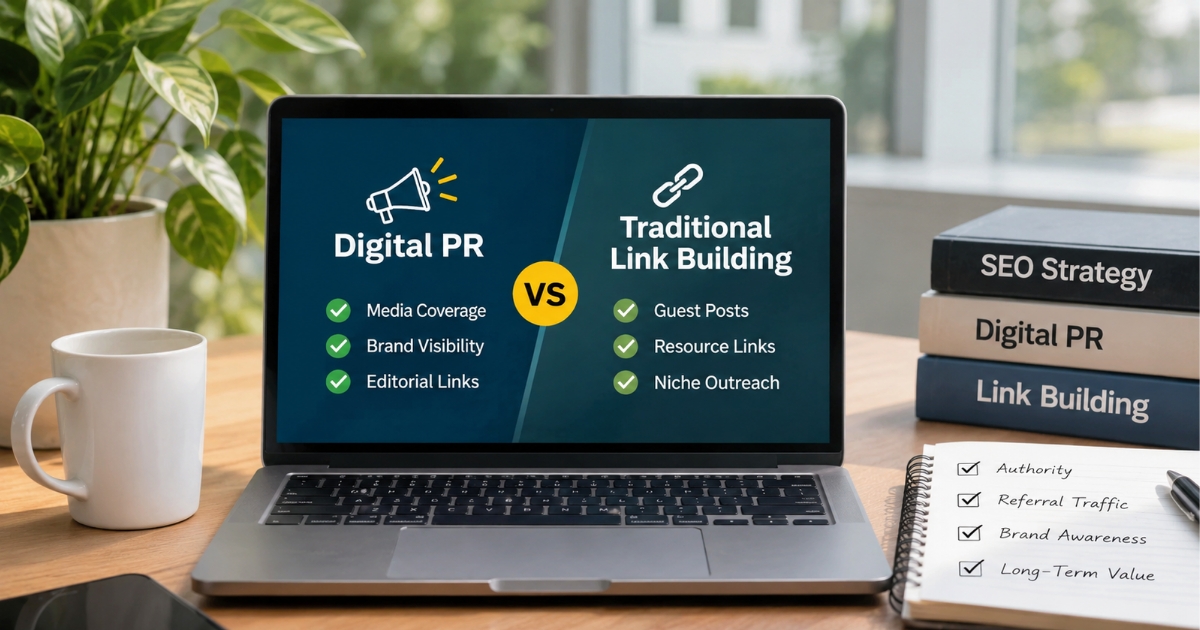
Digital PR vs Traditional Link Building
| Factor | Traditional link building | Digital PR |
|---|---|---|
| Primary objective | Acquire relevant links | Earn coverage and recognition |
| Starting point | Target pages and opportunities | Audience-relevant story |
| Acquisition | Direct publisher outreach | Editorial interest and journalist outreach |
| Content | Existing resources or contributions | Often original research or expertise |
| Relationships | Editors, site owners, specialists | Journalists, editors, media |
| Brand exposure | Placement-dependent | May extend beyond links |
| Referral traffic | Often narrow and targeted | Potentially broader, variable |
| Predictability | Depends on publisher decisions | Coverage is uncertain |
| Measurement | Links, relevance, retention, referrals | Coverage, links, mentions, referrals, outcomes |
The boundary is porous: a research campaign can support resource-page outreach, and an expert guest contribution can lead to future media opportunities. The difference is strategic emphasis, not a rigid classification of every placement.
Backlink Quality vs Editorial Value
A backlink should be evaluated for topical relevance, editorial context, publisher credibility, audience fit, visibility, referral potential, accessibility and appropriate link attributes. Ahrefs Domain Rating and Moz Domain Authority are proprietary metrics, not direct Google ranking factors. A niche publication with a modest authority score can be more useful to buyers than an unrelated large publisher.
Compare four placements: a relevant editorial citation of original research, a genuinely useful expert guest contribution, a clearly disclosed sponsored article, and an irrelevant placement purchased for a metric. Each has a different reader purpose, editorial context and potential search value. Google recommends rel="sponsored" for paid placements and explains that nofollow and related attributes are treated as hints. A sponsored placement may still have advertising value without serving as a ranking-credit tactic.
The Long-Term Value of Digital PR
Digital PR can create brand familiarity, expert recognition, qualified referral visits, publisher relationships, reusable research assets and future partnership opportunities. Strong original reports can be repurposed into webinars, presentations, newsletters and updated annual studies. The underlying asset may retain value even when the initial pitching campaign disappoints.
These benefits require careful attribution. Potential publication reach is not actual readership; coverage is not necessarily endorsement; an unlinked mention is not a backlink; and a rise in branded searches may reflect advertising, seasonality or other activity. Media exposure does not automatically cause Google rankings or AI citations. Google’s people-first content guidance supports producing original, useful analysis, but originality alone does not guarantee distribution.
The Long-Term Value of Traditional Link Building
Traditional outreach remains effective where audience precision matters: professional association resources, technical buyer guides, niche journals, expert contributions, broken-link replacement and promotion of existing tools or documentation. For a specialised B2B supplier, a handful of highly relevant technical references may be more commercially useful than national coverage with little buyer overlap.
Its limitations include scaled low-quality outreach, irrelevant guest posting, temporary placements, excessive reciprocal links, paid schemes and links that disappear. These are reasons to prioritise editorial utility and retention, not reasons to reject all traditional outreach. The test is whether the placement remains useful to readers even if its presumed ranking contribution cannot be proven.
Cost, Time and Resource Comparison
| Factor | Traditional link building | Digital PR |
|---|---|---|
| Research | Prospecting and link analysis | Story validation and data analysis |
| Production | Contributions and useful assets | Reports, visuals and press materials |
| Outreach | Relevant publishers and editors | Journalists and media specialists |
| Complexity | Low to high | Often higher for original studies |
| Predictability | Variable | Editorial outcomes often uncertain |
| Brand exposure | Placement-dependent | Can extend beyond links |
| Scalability | Limited by relevance and quality | Limited by repeatable newsworthiness |
Do not apply universal cost-per-link prices or outreach response rates. Account for research, internal hours, contractors, data, design, tools, outreach and unsuccessful attempts. Cost per relevant referring domain equals total campaign cost divided by new relevant referring domains, but this omits media coverage, qualified visitors and reusable assets. A small technical guide promotion may beat an expensive survey for a narrow niche; a strong proprietary dataset may justify a broader PR investment.
Which Strategy Fits Different Businesses?
SaaS: Research-led PR using product insights and technical benchmarks, complemented by targeted developer and resource outreach. Local businesses: Local publications, chambers, legitimate directories and community partnerships, with selective regional PR. Ecommerce: Product-led research, seasonal insights, relevant buying guides and disclosed sponsored activity. B2B: Industry reports, executive expertise and professional publications. Small businesses and startups: Cost-conscious niche outreach, existing asset promotion and selective specialist or local media stories.
No single method fits every business. Select based on audience, available evidence, internal capabilities, competitive conditions and the commercial objective.
How to Measure Long-Term Value
| Measurement layer | Metrics |
|---|---|
| Link acquisition | Relevant referring domains, link attributes, context, target pages and retention |
| Media and brand | Independent coverage, linked/unlinked mentions, publication relevance, qualified reach and share of voice |
| Website performance | Referral sessions, engaged sessions, landing-page actions, organic visibility and branded search trends |
| Business outcomes | Qualified leads, assisted conversions, partnership enquiries, opportunities and reliably attributed revenue |
Use Ahrefs or Semrush for backlink discovery and comparative visibility, Google Search Console for organic search performance, GA4 for referral engagement, media monitoring for coverage, and CRM records for business outcomes. UTM parameters help with links you control but may not be appropriate for independent editorial links. No one tool proves that a campaign caused ranking improvements.
Define link retention as live acquired links divided by the original link cohort, multiplied by 100. Report at baseline, 30, 90, 180 and 365 days where practical. Cost per qualified lead equals campaign cost divided by attributable qualified leads; where attribution is unreliable, report the metric as unavailable rather than zero.
A Hybrid Strategy
A pragmatic integrated approach is to: identify audience-relevant topics; analyse competitors’ editorial references; create a useful original asset; build appropriate journalist and publisher relationships; pitch newsworthy findings; reclaim relevant unlinked mentions where a link helps readers; selectively promote the asset to specialist resource pages; monitor retention and referral quality; assess business outcomes; and improve subsequent campaigns based on evidence.
This allows a single useful asset to support different forms of distribution without turning editorial coverage into a negotiation for followed links.
Practical Decision Framework
| Situation | Recommended approach |
|---|---|
| Limited budget and narrow niche | Targeted traditional outreach |
| Strong proprietary data | Research-led Digital PR |
| Established expert leadership | Thought leadership and Digital PR |
| Relevant broken-link opportunities | Traditional reclamation |
| Need broad media awareness | Digital PR |
| Existing valuable content with weak distribution | Selective outreach or hybrid |
| Balanced long-term acquisition | Hybrid |
| Weak underlying content | Improve the asset before outreach |
These are strategic hypotheses, not guaranteed outcomes. A balanced strategy should be tested against actual campaign costs, placement quality, audience response and business results.
Proposed Study: Beyond Backlinks
Research design (not conducted): Compare two matched groups of websites or campaigns over 90 days. Group A uses relevant guest contributions, resource outreach, broken-link reclamation and targeted publisher relationships. Group B uses original research, expert commentary, journalist outreach and editorial media campaigns. Match or control for industry, baseline authority proxies, budget, campaign size, existing content, site age and search visibility wherever possible.
Track campaign cost, outreach hours, placements, relevant referring domains, editorial links, retention, linked and unlinked mentions, referral sessions, engaged sessions, branded organic query trends and qualified leads where trackable. Test cost efficiency, engagement, breadth of coverage, link persistence, branded demand and attributable commercial outcomes. Record concurrent advertising and site changes.
Suggested phases: days 1–15 for baseline and preparation, days 16–60 for execution, and days 61–90 for analysis. A 90-day window is short for search visibility and link retention; follow-up at six and twelve months is preferable. Report distributions and uncertainty, acknowledge selection bias and do not infer ranking causation from backlinks and rankings moving together.
Final Verdict
Digital PR can create broader editorial recognition, reusable research, referral discovery and relationships. Traditional link building can create precise, durable niche references and efficient distribution of existing assets. Neither is inherently superior or sustainable. A successful Digital PR campaign can fade quickly; a valuable specialist reference can remain useful for years. Equally, a research asset may earn citations long after the initial outreach while weak purchased placements disappear.
The most valuable strategy is the one that creates the strongest combination of relevance, editorial credibility, audience engagement, sustainability and measurable business outcomes relative to cost. Report what links and campaigns accomplished, not merely how many links were acquired.
FAQs
Is Digital PR better than traditional link building for SEO?
Not universally. Digital PR may earn wider media coverage; traditional outreach may reach more relevant specialist audiences.
Does Digital PR always generate backlinks?
No. Coverage can be unlinked, nofollowed or absent.
Are guest posts against Google guidelines?
Not inherently. Scaled contributions intended primarily to manipulate ranking links can violate spam policies.
How can businesses measure Digital PR ROI?
Compare campaign costs with coverage, relevant links, referral engagement, qualified leads and reliably attributable revenue.
Can small businesses benefit from Digital PR?
Yes. Useful local findings and specialist expertise can provide credible media opportunities.
References
- Google Search Central, Spam policies
- Google Search Central, Qualify outbound links
- Google Search Central, A reminder about links in large-scale article campaigns (2017)
- Google Search Central, Evolving nofollow (2019)
- Google Search Central, Creating helpful, reliable, people-first content
- Muck Rack, State of Journalism (2026)
- Search Engine Land, Digital PR for SEO

Written by Muhammed Lisan A
SEO & GEO Specialist in Kerala
Muhammed Lisan A publishes practical, evidence-based research on technical SEO, crawlability, and generative engine optimization (GEO). Based in Kerala, he focuses on how modern search engines and AI answer systems discover, index, and cite content.