AI Search
The Changing Economics of Organic Search in the AI Era
AI answers and zero-click results are unbundling the value of organic search. A research-led look at traffic, intent, content costs, brand demand and outcome-based measurement.
By Muhammed Lisan A · · Updated
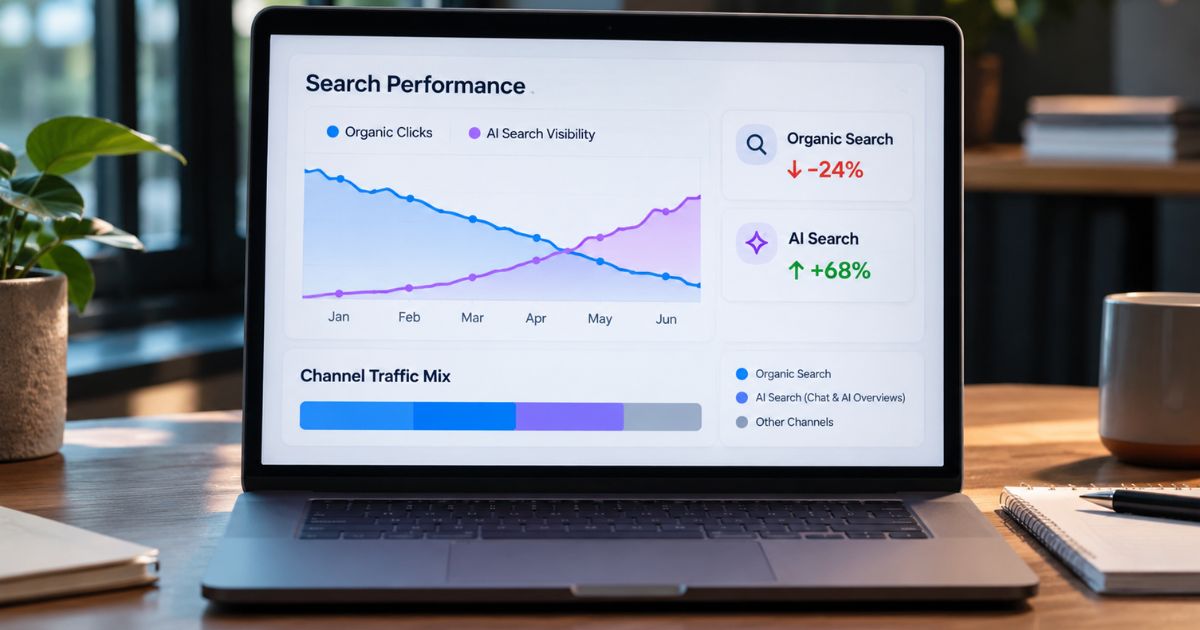
For roughly two decades, the commercial logic of organic search fitted in one line: rank, earn the click, convert the visit. Forecasts, retainers, content calendars and the case for publishing the hundredth guide on a topic all hang from that chain. The click was the unit of exchange between the people who made content and the platform that organised it.
That exchange is under strain. Across several independent datasets, a growing share of Google searches ends on Google. AI Overviews answer questions above the links, AI Mode answers them instead of the links, and assistants such as ChatGPT answer them somewhere else entirely.
The easy conclusion is that organic search is losing its value. The evidence does not support that conclusion in that form. It supports something narrower and more useful: the value of organic search is being unbundled. Traffic volume, which used to stand in for almost everything else, is becoming a weaker proxy for visibility, brand demand and revenue. Some of those outcomes are eroding, some are untouched, and some have moved to places analytics cannot see.
This article follows the economics rather than the trend list. It asks what the click was worth, what changes when it disappears for some queries but not others, what the evidence says about AI referrals and citations, and what that means for content investment and measurement. Where studies disagree, it explains why. Where the evidence runs out, it says so.
The traditional economics of SEO: cheap visits, compounding assets
The business case for organic search rested on a chain: a page ranks, a share of searchers click, some of those visitors engage, a smaller share become leads or customers. Rankings mattered because position drove click-through. Even so, click-through was never universal. Ahrefs' baseline for informational keywords in December 2023 put average position-one CTR at roughly 7.6% of impressions ( Ahrefs February 2026 update ). The model never needed most searchers to click. It needed enough clicks, on enough queries, at a low enough cost per visit.
That cost structure made SEO attractive. A page is mostly a fixed cost: research, writing, design, review and some upkeep. Each extra visit adds almost nothing, and a page that keeps ranking keeps earning. Paid search is the mirror image, because every click is bought and supply stops when the budget does. In Graphite's analysis of the largest US sites, about nine in ten Google clicks went to organic results rather than ads (Graphite and Similarweb, January 2026), a reminder of how much web discovery has run on unpaid placement.
Informational content fitted this model well. A guide answering a research-stage question attracts people who will mostly never buy, but the visits are cheap, a small share become leads, and the page can collect links, mentions and brand familiarity along the way. In effect it worked like an option on future demand: a low premium, an uncertain payoff, and positive expected value as long as visits stayed cheap.
Two properties of the results page held that logic together. Links were the main route to an answer, and visits were easy to count. Neither is as true as it was.
Search engines are becoming answer engines
Answering on the results page is not new. Featured snippets, knowledge panels and direct answers have trimmed clicks for years. Graphite notes that snippets appeared on around a fifth of results pages before AI Overviews, which now appear on roughly 30%, based on Ahrefs' July 2025 analysis of one million results pages ( Graphite ). What changed is breadth and fluency: a generated summary can respond to long, conversational questions that a snippet never could.
How widespread this is depends on who is counting. SparkToro's 2026 study, built on Similarweb clickstream data for January to April 2026, found AI Overviews on more than 20% of US Google searches ( Search Engine Land coverage ). Ofcom's Online Nation report, published in December 2025, found that around 30% of UK keyword searches deliver AI-supported overviews and that 53% of UK adults say they often see AI summaries ( Ofcom ). One is a share of searches in a US clickstream panel; the other is a share of UK keyword queries. They are different measures and should not be merged into one number.
AI Mode matters more for the future than the past. Google said at I/O 2026 that AI Mode had passed one billion monthly users, yet SparkToro found only 0.34% of searches in its January–April sample moved into it ( Search Engine Land ). The shifts in click behaviour between 2024 and 2026 cannot be pinned on AI Mode. The open question is what happens as its use grows.
Google's own account differs in emphasis. In August 2025, its head of Search said total organic click volume was relatively stable year over year and that Google was sending slightly more quality clicks, meaning fewer visitors who bounce straight back ( Google ). Search Engine Land noted that the post did not publish the underlying figures or say who gained and lost ( Search Engine Land ). Google's documentation adds that there are no extra requirements to appear in AI Overviews or AI Mode, and that AI Overviews show only when they add something beyond classic results, so they often do not trigger ( Google Search Central ). Read economically, Google is describing fewer, better clicks. That is compatible with falling traffic and an uncertain effect on revenue, which only outcome data from your own site can settle.
Until recently, site owners could not even isolate AI surfaces. Appearances in AI Overviews and AI Mode were folded into ordinary Web search totals in Search Console. A dedicated generative AI report arrived in June 2026 and has been rolling out globally since, but it reports impressions only, with AI Overviews and AI Mode combined and no click data ( Search Engine Land ).
The zero-click problem, and why the numbers need context
"Zero-click" gets used for four different things. The statistics attached to each are not interchangeable.
| What happened | What is actually measured | Best available evidence |
|---|---|---|
| A search ended without a click | Whether the search produced a click on any result; a follow-up search or leaving Google counts as no click | SparkToro/Datos 2024, SparkToro/Similarweb 2026, Pew 2025 |
| A search sent nobody to an external site | Clicks to the open web, excluding clicks that stay inside Google (Maps, YouTube, Shopping) | SparkToro 2024: 374 open-web clicks per 1,000 US Google searches, 360 in the EU |
| A user saw a brand but did not visit | Impressions, citations and mentions, with no standard metric | Search Console generative AI impressions (since June 2026), Bing citation counts (since February 2026), third-party prompt tracking |
| A user clicked an AI citation | A referral from an assistant or an AI feature | Pew: 1% of visits to pages with an AI summary included a click on a cited link; assistant referrals in GA4 samples (next section) |
The headline rates disagree with each other. SparkToro's 2024 study, using Datos clickstream data, put zero-click at 58.5% of US and 59.7% of EU Google searches ( SparkToro ). Its 2026 follow-up, built on Similarweb data, put the US rate at 68.01% for January to April 2026 ( Search Engine Land ). Meanwhile Datos's own Q1 2026 report , which covers desktop users only and uses a narrower definition, recorded US zero-click at 22.4% in March 2026, down from 24.5% in December 2025 ( PPC Land's summary ). None of these is wrong. They use different panels, different device mixes (SparkToro assumed two-thirds mobile) and different definitions, and SparkToro itself cautions that its long-run series stitches together different data sources. The defensible reading is directional: SparkToro's studies point toward more searches ending on Google, Datos's desktop panel shows a one-quarter dip, and neither measures what your own site sees.
The same caution applies to traffic. Ahrefs found that AI Overviews correlated with a 34.5% lower position-one CTR in a March 2025 comparison, and 58% lower in an update using December 2025 data ( Ahrefs , update ). Seer Interactive recorded a 61% fall in organic CTR on AI Overview queries between June 2024 and September 2025, and a 41% fall on queries without one ( Seer ). Pew's browsing panel found people clicked a traditional result on 8% of visits with an AI summary against 15% without ( Pew ). Yet Graphite and Similarweb, looking at organic visits to the 40,000 largest US sites, found only a 2.5% decline across 2025 compared with 2024, concentrated in mid-sized sites and in news, health, cooking and entertainment; Graphite's author discloses a commercial interest in SEO being healthy ( Graphite ). Chartbeat's data on 2,576 news sites shows Google search referrals down 33% globally and 38% in the US between November 2024 and November 2025 ( Press Gazette ). And SEOcrawl's analysis of 16,661 connected sites found Google clicks down 15% while impressions were flat, with the median site losing 20% and mid-sized sites losing most ( SEOcrawl ).
These results coexist because they answer different questions. CTR studies look at queries where an AI answer appears, a minority of searches. Traffic studies average over every query, including those untouched by AI features, and over changes in search demand. Population matters, because very large sites, mid-sized sites, news publishers and self-selected analytics users behave differently. The metric matters too, because visits, clicks, CTR and impressions each move for different reasons.
Ratios add a trap of their own. Seer's 2026 update found that CTR fell for brands cited in AI Overviews even though clicks had not, because exposure grew faster than clicks ( Seer ). SEOcrawl noted that a September 2025 change in Google's results-per-page behaviour altered reported impressions, so it relied on clicks. A falling CTR is not automatically a falling business metric, and a steady one is not automatically safe.
Most of this evidence is observational, which makes cause hard to isolate. Seer's fall on queries without AI Overviews, and Ahrefs' finding that CTR on informational keywords without AI Overviews roughly halved between December 2023 and December 2025, suggest AI Overviews are not the only force at work. Ads, other results-page features and changing behaviour also take clicks. The strongest causal evidence so far is a preregistered field experiment posted to arXiv in August 2026, a preprint that has not been peer reviewed. Researchers randomly assigned about 1,100 US Chrome users, in March 2026, to normal Google, a version with AI features suppressed, or a version that routed every search into AI Mode. Forcing AI Mode cut clicks to external sites by 18.8 percentage points relative to normal Google. Suppressing AI features raised them by 8.8 points, although suppression worked only about half the time, so that estimate is adjusted ( Search Engine Land , arXiv:2608.18352 ). It shows what happens when AI Mode becomes the default, not what happens when people choose it.
The safe conclusion is narrower than the headlines. Where an AI answer appears, clicks to results fall, and the fall looks larger for informational, non-branded queries. How much of your traffic sits on those queries is the number that matters, and no industry average can supply it.
AI search and the changing value of website traffic
Small referral volumes, fast growth in some datasets, stalls in others
Assistants exist to answer questions, not to route people elsewhere, and the data are consistent with that. Similarweb found that visits to generative AI platforms rose 28.6% in the US between January 2025 and January 2026 while the referrals those platforms sent to external sites stayed flat ( Similarweb ). Two recent GA4 samples show the scale. Marie Haynes's analysis of 100 websites and more than 145 million sessions over 12 months found that ChatGPT sent 0.62% as many sessions as Google organic search, or 0.73% with every other assistant added ( Search Engine Land ). SEOcrawl, using 3,949 sites with analytics data, counted 1.25 AI-referred sessions per 100 Google organic sessions between March and August 2026, roughly double the ratio a year earlier, with AI referrals up about 45% ( SEOcrawl ). Both undercount. Visits from some assistant apps arrive without referrer data and show up as direct traffic, and clicks from Google's own AI features are reported as ordinary Google organic.
For a sense of relative scale, Ofcom reported 252 million UK web visits to ChatGPT in August 2025, against about three billion Google web searches a month in the UK ( Ofcom ). Those are different units, so read it as a rough gap rather than a ratio.
A conversion premium that is real in places but not stable
Several samples show AI-referred visitors converting better. Ahrefs reported that AI search drove 0.5% of visits to its own site and 12.1% of sign-ups in a 30-day window to June 2025 ( Ahrefs ), a single-site result for a company with an unusually tool-literate audience. Haynes found 13.8% conversion for ChatGPT visitors against 3.02% for Google organic across the 55 sites that tracked conversions, although 45 of the 100 sites tracked none and Google organic still produced 96.5% of all conversions in the sample. Similarweb reports 7% against 5% on transactional sites. Adobe's US retail data show how unstable the premium is: in July 2025 an AI-referred visit was worth about 27% less than a non-AI visit ( MediaWeek ), while by July 2026 AI referrals delivered 53% more revenue per visit and 60% higher conversion ( Chief Marketer , Adobe ).
A range running from a discount to roughly 23 times is the real finding. A conversion premium is not a constant to plan around. It may also reflect selection rather than channel power: someone who clicks through after an assistant has already summarised the options has pre-qualified themselves. That is analysis, not a measured result, but it suggests AI referrals are better read as a filter on existing demand than as a source of new demand.
Value without a click: plausible, not yet measured
The case that AI visibility is valuable even without referrals rests on three kinds of evidence, none of which proves it. Seer Interactive found that brands cited in an AI Overview earned 35% more organic clicks than uncited brands on the same queries in Q3 2025, and in its 2026 update 120% more organic clicks per impression, while still sitting 38% below queries with no AI Overview; the authors say they cannot prove citation causes the advantage ( Seer 2025 , Seer 2026 ). Ahrefs' study of 75,000 brands found branded web mentions correlated with brand presence in AI Overviews (0.664) far more strongly than backlinks (0.218), a correlation that does not say which causes which ( Ahrefs ). And a Similarweb consumer panel in January 2026 found 35% of US consumers using AI tools at the product discovery stage against 13.6% using search, a self-reported figure from a vendor of AI-visibility products ( Similarweb ).
What is missing is a study connecting an AI mention to downstream sales, branded search or pipeline. Until one exists, "mentions create value" is best treated as a hypothesis with good circumstantial support.
Is the web's traffic exchange changing?
Cloudflare's crawl-to-referral ratio compares how many pages a platform fetches with how many visits it sends back. In July 2025 Cloudflare reported roughly 5 crawls per referral for Google, about 1,091 for OpenAI, about 195 for Perplexity and about 38,065 for Anthropic, down from nearly 287,000 in January ( Cloudflare ). Nearly 80% of AI crawling was for training, which returns no referrals by design, so the ratio overstates the imbalance for search-grounded retrieval, and it is a mid-2025 snapshot that has since moved. Still, it quantifies a real change. The old bargain, in which a search engine crawls your pages and sends you visitors, is not how AI platforms work.
Publishers' outlook reflects it. In the Reuters Institute's January 2026 survey, 280 media leaders in 51 countries expected search traffic to fall about 43% over three years ( Reuters Institute , Press Gazette ), which is a forecast, not a measurement. Site owners now also have levers they lacked before. OpenAI separates OAI-SearchBot, which governs ChatGPT search, from training crawlers, and sites opted out of OAI-SearchBot are not shown in ChatGPT search answers ( OpenAI ). Google has added a Search Console control for generative AI features ( Search Engine Land ). Inclusion in AI answers has become something a business can choose to price in or out.
What the evidence supports
| Confidence | Claim | Basis |
|---|---|---|
| Established | Where an AI answer appears, clicks to results fall, most clearly on informational, non-brand queries | Several observational studies plus one randomised preprint |
| Established | Assistants currently send a small fraction of Google's referral volume | Haynes, SEOcrawl, Similarweb |
| Probable | AI-referred visitors are better qualified on average, with a premium that varies widely | Ahrefs, Haynes, Similarweb, Adobe |
| Unproven | AI mentions create demand without clicks | Correlations only |
| Unproven | AI referrals will offset lost Google clicks, or Google's higher-quality clicks offset lower volume | No independent data |
Not every organic click has the same economic value
The value of a click is the probability it converts, times what a conversion is worth, plus any indirect effect on later demand. All three terms vary by intent, and AI features do not hit every intent equally.
Exposure clusters on research-style questions. In Ahrefs' 2025 study of 300,000 keywords, 99.2% of the keywords that triggered an AI Overview were informational ( PPC Land's summary ). Graphite, citing Ahrefs ' analysis of a million results pages, reports AI Overviews on about 13% of branded keywords and 25% of non-brand ones ( Graphite ). Pew found that only 8% of one- or two-word searches produced an AI summary, with longer, question-style searches triggering them more often ( Pew ).
The picture is not static. Peec, a vendor of AI-tracking software, analysed 500,000 prompts in April 2026 and found AI Overviews on 88.5% of bottom-of-funnel commercial prompts ( Peec ). That sample is conversational prompts, not keywords drawn from a database, so it describes a different slice, the long, natural-language slice where Pew says AI summaries are most common. The studies do not contradict each other, but together they say commercial queries are not safe by default. Your own exposure depends on which queries you actually rank for.
Informational searches
This is the highest-exposure, lowest-direct-value class. Graphite found news, health, cooking and entertainment sites lost more than 10% of organic traffic while clothing, shopping and marketplace sites grew. SEOcrawl's median-site figures show jobs (−38%) and SaaS and tech (−24%) losing the most Google clicks, against −4% to −8% for gaming and gambling. For some sites the lost visits were never the ones that paid the bills. For others they were the top of a funnel nothing has replaced. Which applies to you depends on whether informational visitors later buy, which is an assisted-conversion question.
Commercial investigation
Comparison and "best of" queries sit in contested territory. This is where people weigh options, where AI answers recommend some brands and omit others, and where being cited seems to matter most. Measured data are thinnest here, and in my analysis this is where results will vary most between sites.
Transactional searches
These end in a purchase or enquiry, and a transaction needs a site. SparkToro's Rand Fishkin said branded, local and high-intent transactional searches still benefit significantly from SEO ( Search Engine Land ). Two cautions apply: some of these clicks go to Google's own surfaces such as Shopping and Maps, and the Peec data suggest the protection is eroding. The remaining clicks are comparatively valuable, which is why a small loss here can matter more than a large loss elsewhere.
Local searches
Local intent resolves through map listings and business profiles, and the valuable action may be a call, a direction request or a visit that website analytics never see. I found no rigorous 2026 study on local conversion shifts, so this rests mainly on Fishkin's comment. Google's own guidance lists keeping Business Profile and Merchant Center information current among practices for AI features ( Google Search Central ). Measure calls and direction requests, not only sessions.
Branded searches
Branded queries are the highest-intent and most defensible organic traffic, and AI Overviews appear less often on them. Brand demand is also the asset other channels feed. Fishkin's recommendation is to invest in brand awareness where audiences already spend time, even when that does not produce visits ( Search Engine Land ). Branded demand is a lagging indicator, so it cannot be built with the same tactics that win informational clicks.
A hypothetical shows why the distinction matters. Suppose a how-to guide gets 10,000 visits a month with an assigned value of $0.10 per visit, and a category page gets 800 visits at $4.00 (both numbers invented). The guide yields $1,000 and the category page $3,200. A 40% click loss on the guide costs $400 and looks catastrophic on a sessions chart. A 10% loss on the category page costs $320 and barely registers. The sessions graph and the revenue graph tell different stories, and this ignores any indirect value the guide has, which is exactly what is worth measuring.
The content production model is under pressure
Volume-based content strategies rest on a simple ratio: cost per page divided by visits per page. AI features attack the denominator.
Here is an illustration, not data. Suppose a guide costs $900 a year to produce and maintain and earns 3,000 visits, or $0.30 a visit. If AI answers remove 40% of those clicks, an assumption inside the range the studies above report for affected queries and not a forecast, visits fall to 1,800 and cost per visit rises to $0.50, a 67% increase for the same page. With an unchanged conversion rate, cost per lead rises by the same proportion. A portfolio of hundreds of such pages repeats the effect hundreds of times. Maintenance is the quieter cost: informational pages decay, and the more of them a site runs, the more upkeep scales regardless of whether traffic does.
Supply is shifting too. Graphite's analysis of 65,000 URLs sampled from Common Crawl estimates that about half of new web articles are now primarily AI-generated, a share that plateaued during 2025 ( Axios ). Graphite's companion analysis found that 86% of articles ranking in Google, and 82% of those cited by ChatGPT and Perplexity, were human-written, and AI-written articles that did rank tended to rank lower ( Graphite ). This is observational. It relies on an AI detector, excludes paywalled sites, and cannot say whether AI authorship causes weaker performance or whether AI-written articles are simply more often thin, unlinked or published on weaker sites; researchers told Axios that no definitive count is possible with current tools. What it does support is a market point. When a competent generic article is cheap for everyone, a competent generic article is worth less.
Which informational content keeps earning its place? Three tests, framed as hypotheses consistent with the evidence rather than findings:
- Does the page need the click to deliver its value? Tools, calculators, datasets and templates cannot be fully replaced by a summary.
- Is it differentiated by original data, first-hand testing or genuine expertise? Similarweb's vendor study of AI brand visibility found specialist, well-structured content outperforming brand scale in AI mentions, and Seer's data show cited brands earning more clicks than uncited ones.
- Can you show that it feeds conversion indirectly? Assisted conversions, sales enablement and email sign-ups are evidence. An assumption is not.
The risk worth naming is producing content mainly to harvest informational clicks. It concentrates exposure in the query class most affected, depends on a channel the platform is deliberately narrowing, and competes with effectively unlimited machine-generated supply. The risk of overcorrecting is just as real. AI Overviews appeared on roughly a fifth to a third of searches in the studies above, many valuable informational queries still send clicks, and Google's guidance continues to point to helpful, reliable content with no special markup required. The evidence does not support abandoning informational content wholesale. It supports reviewing it by outcome.
Measuring organic search beyond sessions and rankings
A rankings report answers where a site appears. A traffic report answers how many people came. Neither answers the question the business is actually asking: what did organic search earn, and at what cost? Both are weaker proxies than they used to be. Rankings no longer predict clicks where an AI answer sits above them, and traffic counts visits that may have been worth very little.
| Metric | How reliable today | Notes |
|---|---|---|
| Organic clicks, segmented by intent and brand versus non-brand | High | Search Console data; clicks from AI Overviews and AI Mode are folded into Web totals. Track clicks, not CTR. |
| Conversions and revenue per organic session | High, where conversion tracking exists | Haynes found 45 of 100 sites tracked no conversions. Segment by landing-page group and intent. |
| Branded search clicks and impressions | High as a proxy, not causal | Movement can reflect campaigns, PR or seasonality as much as AI visibility. |
| Assisted conversions and path analysis | Medium | GA4 paths are limited by consent and cross-device gaps, and tend to undercredit upper-funnel content. |
| Impressions in Google’s AI features | Medium, since June 2026 | AI Overviews and AI Mode are combined, and there is no click data. |
| Citations in Bing and Copilot | Medium, since February 2026 | Citation counts, cited pages and grounding queries; no click data; Microsoft’s ecosystem only (Search Engine Journal). |
| ChatGPT referrals | Medium | Tagged with utm_source=chatgpt.com for sites that allow OAI-SearchBot (OpenAI); some app visits arrive without a referrer and count as direct. |
| Brand mention share across assistants | Low to medium | Available only through third-party prompt sampling; results depend on prompts, location and model version. |
| Causal effect of AI mentions on sales | Not reliably measurable | Imperfect proxies: “how did you hear about us” answers, branded search lift, geographic holdout tests. |
| Organic customer acquisition cost | Medium | Fully loaded programme cost (content, tools, people) divided by customers attributed; report it as a range because attribution has gaps. |
Three practical implications follow.
Separate the numerator from the denominator. Seer's finding that CTR fell while clicks held steady is a reminder that ratios can mislead when exposure changes. Report clicks, impressions and CTR side by side, and explain which one moved.
Segment before you conclude. Group queries by intent and by brand versus non-brand, then compare cohorts. The generative AI report in Search Console can show which pages appear in AI features, and comparing clicks on those pages before and after is a reasonable, if correlational, test.
Treat visibility metrics as leading indicators, not outcomes. A citation count is to AI search what a ranking was to classic search: a position, not a result. The result is revenue, leads or retained customers, and the cost of getting them.
What businesses should reconsider about SEO investment
Nothing below is a prediction. These are adaptations that follow from the evidence, with the level of confidence stated.
SEO agencies
Reporting built on rankings and traffic becomes harder to defend. The better-supported alternative is revenue or qualified leads per organic session by intent cohort, with an honest baseline of how much of the client's traffic sits on AI-exposed queries. Promising traffic growth on informational queries carries more risk than it did, and scoping that assumes a stable click curve deserves a second look.
In-house teams
Budget conversations will be won with outcome data. Before debating AI-visibility spend, check that conversion tracking exists at all, given how many sites in Haynes's sample had none. Allocate effort by intent exposure rather than by keyword volume.
Publishers
Publishers have the strongest evidence of damage: Chartbeat's 33% global decline in Google referrals to news sites, and leaders expecting further falls. The Reuters Institute report shows publishers prioritising subscriptions and memberships, which fits the logic of owning the relationship rather than renting attention. Whether that is enough is untested.
SaaS companies
The median SaaS and tech site in SEOcrawl's data lost 24% of Google clicks, and top-of-funnel educational content is the most exposed class. A reasonable hypothesis, not a finding, is that product-adjacent assets such as tools, integrations, documentation and comparison pages hold up better because they need the visit to deliver value.
E-commerce businesses
Transactional intent looks less exposed, SEOcrawl's median e-commerce site saw AI referrals grow about 54%, and Adobe's retail data show higher revenue per AI-referred visit in mid-2026. Google's guidance points to accurate structured data and Merchant Center information as relevant to AI features. Treat the AI premium as unstable, as the 2025 reversal shows.
Local businesses
Business Profile accuracy, reviews and the actions that never reach a website (calls, directions, bookings) deserve at least equal weight with site sessions. The evidence base here is thin, so measure rather than assume.
Independent creators
Studies disagree on whether small sites are shielded: Graphite found the smallest sites grew, while SEOcrawl's smallest size band lost about 14% of Google clicks. Different samples explain much of that gap, and creators should not rely on either. Owned audiences such as email lists and communities do not depend on a platform's click policy, though that is an argument from structure rather than evidence.
A portfolio test before the next content budget
- Classify existing pages by intent and by brand versus non-brand.
- Calculate revenue or leads per organic session for each cohort.
- Use the Search Console generative AI report and manual checks to find which cohorts are exposed to AI features.
- Estimate cost per visit and cost per lead for each cohort, including maintenance.
- Decide per cohort whether to invest, maintain, merge or stop, and revisit quarterly, because the underlying data are still moving.
Conclusion: organic search is changing, not disappearing
The most reliable summary of the evidence is also the least dramatic. Search has not collapsed. Graphite's panel of large US sites saw organic visits slip only 2.5%, and in the samples that measure conversions, Google organic still produced the overwhelming majority of them. What has changed is the exchange rate between visibility and visits. On queries that an AI answer can satisfy, visibility now yields fewer clicks, and the studies that can isolate the effect find it substantial.
That shifts where organic search creates value. Direct value concentrates in high-intent clicks that need a site, in brand demand that makes people search for you by name, and in being the source an AI answer cites. The cheap, high-volume informational visit, long treated as the default return on content, is the part most under pressure, and the economics of producing it have worsened even if its value has not vanished.
The practical task is to stop treating all organic traffic as equal. Segment by intent, measure revenue per session and cost per outcome, treat AI visibility as a leading indicator, and keep an explicit list of what you cannot yet measure. Some of today's figures will not survive the next year's data. A strategy built on outcomes will survive them better than one built on sessions. For how I approach SEO and GEO measurement in practice, see the services page .
References
- SparkToro, 2026 zero-click study (Similarweb data).
- Search Engine Land coverage of the 2026 study.
- SparkToro, 2024 zero-click study (Datos data).
- Datos, State of Search Q1 2026.
- Datos, State of Search Q1 2026. — additional source 2
- Pew Research Center, July 2025.
- Ahrefs, AI Overviews and CTR (April 2025; February 2026 update).
- Ahrefs, AI Overviews and CTR (April 2025; February 2026 update). — additional source 2
- PPC Land summary of the 2025 Ahrefs study.
- Seer Interactive, AI Overview CTR (September 2025; April 2026).
- Seer Interactive, AI Overview CTR (September 2025; April 2026). — additional source 2
- Graphite and Similarweb, January 2026.
- Graphite, AI content in search and LLMs (October 2025).
- Axios on Graphite's AI-content analysis.
- Similarweb, generative AI statistics.
- Ahrefs, AI search traffic and conversions (June 2025).
- Ahrefs, 75,000 brands study (May 2025).
- Search Engine Land on Marie Haynes's study (October 2026).
- SEOcrawl, AI traffic versus Google organic (October 2026).
- Adobe AI traffic trends report, August 2026.
- Chief Marketer on Adobe's data.
- MediaWeek on Adobe's 2025 data.
- Cloudflare, crawl-to-click gap (August 2025).
- Peec, AI Overviews by query intent (April 2026).
- AI Mode field experiment, arXiv:2608.18352 (August 2026).
- AI Mode field experiment, arXiv:2608.18352 (August 2026). — additional source 2
- Reuters Institute, Journalism, Media and Technology Trends and Predictions 2026.
- Reuters Institute, Journalism, Media and Technology Trends and Predictions 2026. — additional source 2
- Ofcom, Online Nation 2025.
- Google Search Central, AI features and your website.
- Google Search blog, AI in Search (August 2025).
- Search Engine Land on that post.
- Search Engine Land on Search Console AI reporting and controls.
- Search Engine Journal on Bing Webmaster Tools AI Performance.
- OpenAI, publishers and developers FAQ and crawler documentation.
- OpenAI, publishers and developers FAQ and crawler documentation. — additional source 2

Written by Muhammed Lisan A
SEO & GEO Specialist in Kerala
Muhammed Lisan A publishes practical, evidence-based research on technical SEO, crawlability, and generative engine optimization (GEO). Based in Kerala, he focuses on how modern search engines and AI answer systems discover, index, and cite content.