GEO
Does Schema Markup Help AI Understand a Business Better?
A testable hypothesis, a reproducible experiment and an honest read of the evidence on whether schema helps AI state a business's facts correctly.
By Muhammed Lisan A ·
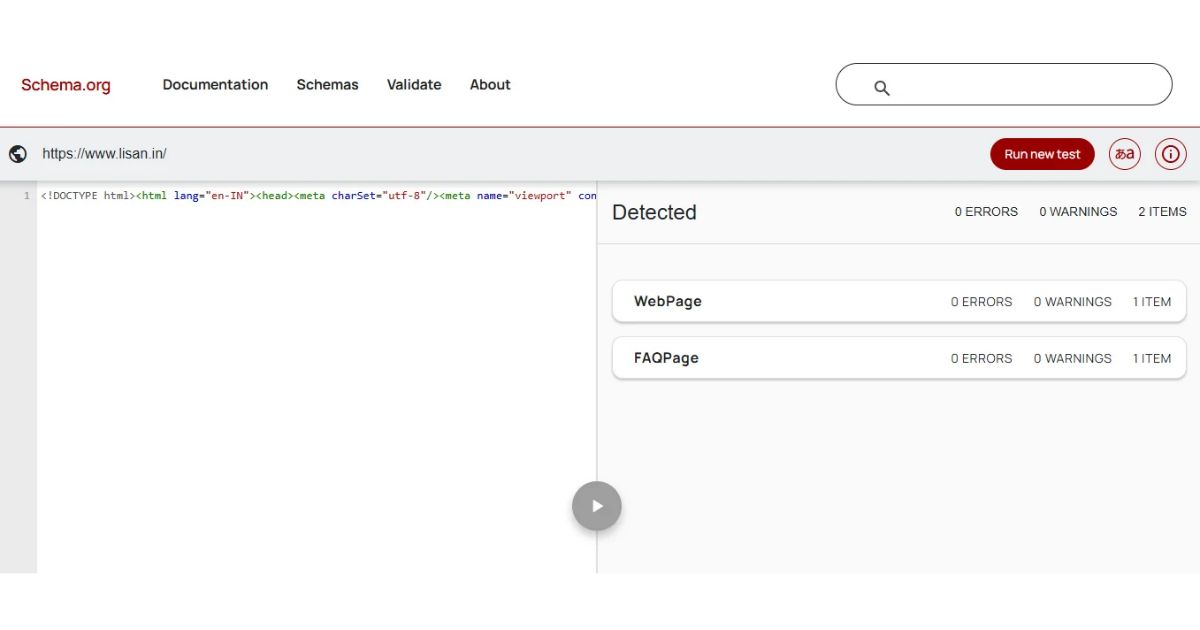
A testable hypothesis, a reproducible experiment, and an honest read of the evidence. Sources checked October 2026.
Schema markup is currently sold as the way AI “understands” your business. It is also dismissed as dead code that AI never reads. People on both sides often cite the same handful of tests.
I think the argument is stuck because it keeps asking the wrong question. “Does schema increase AI citations?” is one question. “Does schema help an AI system state a business’s name, services, location and contact details correctly and consistently?” is another. Most of the public evidence addresses the first.
This article separates the two and proposes an experiment for the second. I haven’t run it yet. There are no results to report, and nothing here should be read as a finding.
How I label claims
- Documented: stated in official provider documentation.
- Reported: a third-party test or a conference statement, not documentation.
- Hypothesis: plausible, but untested.
- Open: nobody has publicly shown it, as far as I could find.
The central hypothesis, and why it matters for GEO
Business facts go wrong in AI answers all the time. A service area is merged with a competitor’s, or an old address is repeated. Schema is a cheap way to state those facts unambiguously, so the question is worth testing.
My working hypotheses are:
- H1 (accuracy): When visible content is equally clear, a page with valid, matching structured data produces more correct attributes in AI answers than a page without it.
- H2 (consistency): The same prompt, repeated, returns more stable answers for the schema page.
- H3 (attribution): AI systems cite the schema page’s own URL for more attributes.
- H0: There is no measurable difference.
- H4 (extension): Incomplete or contradictory schema produces more wrong or ambiguous answers than no schema.
Note what is not claimed: that schema earns more citations. Citation frequency and interpretation accuracy are different outcomes, and only the first has been tested at scale.
If you are interested in the citation side of GEO, see my related test plan: does a direct answer make a page more citable by AI systems.
What schema communicates to search engines
Schema.org markup, usually as JSON-LD, labels what a page is about in a machine-readable form. Google’s documentation describes it as input its systems consider. It makes pages eligible for certain features and rich results, provided the markup follows the guidelines and matches visible content (Google Search Central, May 2025).
Google’s LocalBusiness documentation shows how narrow “supported” is:
- It requires only name and address for a local business, and recommends the most specific subtype available, such as Restaurant or DaySpa.
- It notes that LocalBusiness is a subtype of Organization, so Organization fields apply as well.
- It warns that Google doesn’t guarantee features that consume structured data will appear, and that after a structured-data manual action the markup is ignored.
The most common mistake in this debate is treating five different things as one:
| Layer | What it is | Status |
|---|---|---|
| Structured-data processing | Parsing and validating markup | Documented by Google; Reported for Microsoft |
| Entity understanding | Deciding what a business is and what it does | Largely opaque; schema is a plausible input (Hypothesis) |
| Retrieval | Crawling, indexing and fetching pages | Documented per provider; none document schema as a retrieval requirement |
| Answer generation and citation | The model writing an answer and choosing sources | Opaque (Open) |
| Rich result eligibility | Specific Google Search features | Documented feature by feature, and separate from AI answers |
Valid JSON-LD can pass layer 1 and still never matter for layers 2 to 4.
What is documented about AI systems and structured data
Google (AI Overviews, AI Mode)
This is the clearest and least exciting position. Google’s AI features guide says appearing in AI Overviews or AI Mode needs no extra technical requirements beyond normal Search eligibility (indexed, snippet-eligible), and that no special schema.org markup is needed. The same guide tells site owners to make sure structured data matches the visible text and to keep Business Profile and Merchant Center information current.
Google’s generative AI optimization guide goes further. It explains that Google’s AI features rely on retrieving pages from the Search index (grounding) and on query fan-out. It also lists “overfocusing on structured data” among the myths, saying structured data isn’t required and no special markup exists, but that it remains worth using for rich result eligibility.
Microsoft (Copilot, Bing)
This is the one major provider with a direct statement. Fabrice Canel of Bing said on stage at SMX Munich that schema markup helps Microsoft’s LLMs understand content (Search Engine Land). That is Reported, not documentation, and it doesn’t say how or how much. Microsoft also added an AI Performance report to Bing Webmaster Tools in February 2026, covering citations in Copilot and Bing AI summaries (coverage).
ChatGPT search
OpenAI documents OAI-SearchBot as the crawler that surfaces sites in ChatGPT search, and says opted-out sites won’t appear in search answers (OpenAI crawlers). In the documentation I reviewed, I found nothing about Schema.org. That is a silence, not a denial.
Perplexity
Perplexity says PerplexityBot is designed to surface and link websites in its search results, and isn’t used to crawl content for foundation models (Perplexity crawlers). I found no statement about schema there either.
Independent tests (all Reported)
| Test | What it shows | What it cannot show |
|---|---|---|
| Ahrefs, May 2026 | 1,885 pages that added JSON-LD (Aug 2025 to Mar 2026) were matched against about 4,000 control pages, with no meaningful citation uplift in AI Overviews, AI Mode or ChatGPT | Every page was already heavily cited (100+ AI Overview citations beforehand), and pages adding JSON-LD often change other things too. It doesn’t address pages with no AI visibility. It measures citations, not accuracy |
| Williams-Cook, early 2026 | A fake address placed only inside deliberately invalid JSON-LD, absent from visible text, was still returned by LLMs asked where the company was based. Perplexity even cited the “embedded structured data” as its source | It shows JSON-LD can be read as text during fetch. It does not show systems parse it as Schema.org |
| searchVIU, Oct 2025 (second-hand) | Reportedly, five AI systems fetching a page live extracted only visible HTML, not JSON-LD-only values | I couldn’t read the original. It appears to conflict with Williams-Cook, so treat it as unverified |
The Ahrefs data also gives the origin of the popular “3x” statistic. Across 6 million URLs, AI-cited pages were almost three times more likely to have JSON-LD. That is a correlation, and the controlled follow-up found no citation lift.
The Williams-Cook and searchVIU results look contradictory, but they may not be. They are different fetch pipelines, prompts and dates. “The model can read the text in JSON-LD” and “the model treats it as structured data” are separate claims.
The experiment methodology (proposed, not conducted)
Design
Use two fictional businesses on two separate, newly registered domains, built from the same template. Randomly assign which one gets schema.
- Test A: Clear visible business information, no structured data.
- Test B: Identical visible information plus valid, matching JSON-LD (a WebSite, WebPage, LocalBusiness-subtype and Service graph, as in the example later in this article).
Fictional entities remove prior knowledge, Business Profiles and third-party citations. That is also the main weakness. Established real brands have corroboration your test businesses won’t, so results may not transfer to them.
Put a visible line on both pages saying they are fictional businesses created for a search experiment. Use a different, clearly fictional address and phone number for each. Don’t use a real person’s details. Check that the invented names return no collisions in search.
Variables
- Independent variable: presence of valid, matching JSON-LD.
- Dependent variables: per-attribute accuracy; consistency across repeated runs; missing-attribute rate; incorrect or invented attribute rate; whether the test page is cited; type of source cited.
- Held constant: visible copy (same word count and heading structure); layout and internal link structure; hosting and robots rules; sitemap submission and publish date; indexing requests made on the same day; server-rendered output on both; no backlinks, and no Business Profile or directory listings for either site.
Attributes and scoring criteria
| Attribute | Visible on page | Schema property (Test B) | Scoring |
|---|---|---|---|
| Business name | Header, title, About | name | Exact, partial, wrong, missing |
| Business type | Intro sentence | Specific @type subtype | Same |
| Services | Services section | Service nodes | Count correct, missing and invented |
| Address | Contact section | address, geo | Component-level match |
| Service area | Text on the page | areaServed | Exact, partial, wrong, missing |
| Website | Footer | url | Exact URL or domain |
| Contact details | Contact section | telephone, email | Exact match |
Score each answer as Correct, Partially correct, Incorrect (a wrong value) or Missing. Log the source type as the test page, a third party, or none and unknown. Ideally a second person scores responses with the arm labels removed.
Validating the schema
- Run the Test B code through the Schema Markup Validator. It is a general-purpose validator for Schema.org markup, while Google’s Rich Results Test only covers Google-supported rich result types.
- Run the live URL through the Rich Results Test. LocalBusiness is a supported feature, but don’t expect every type to appear there.
- View the raw page source (not just the browser DOM) and confirm the JSON-LD is in the delivered HTML.
- Diff Test A against Test B so the only difference is the script block.
Checking crawling and processing
Don’t test AI answers until both pages show comparable crawl evidence.
- Google: URL Inspection (indexed version, rendered HTML, detected structured data), the Pages report and the sitemap. Google advises allowing time for recrawling, which may take several days.
- Bing: URL inspection in Bing Webmaster Tools, plus the AI Performance report once available.
- Server logs: Look for Googlebot, Bingbot, OAI-SearchBot and PerplexityBot on both domains.
- Retrieval check: An exact-name search and a site: query for each page.
- Google AI visibility: Use the Generative AI performance report in Search Console, which Google’s guide points to for measuring generative AI visibility. Verify both properties first.
Crawled, indexed and retrievable by an AI system are three separate states. Log each one.
AI testing protocol
Run identical prompts against both arms in each system: Google AI Mode, ChatGPT search, Perplexity and Copilot, with web search on. Use fresh sessions, record the exact mode or model label, date, time and region, and save every response and cited URL.
Starter prompts, with [Business] swapped in:
- What is [Business]?
- Where is [Business] located? Give the full address.
- What services does [Business] offer?
- Which areas does [Business] serve?
- What is [Business]’s website?
- How do I contact [Business]?
- What type of business is [Business]?
- Summarise [Business] and cite your sources.
Run T0 before publishing, to confirm no system already “knows” the entity. Then run weekly rounds.
Suggested scale:
- Fuller version: 8 prompts, 4 systems, 2 arms and 5 runs each is 320 responses per round. Run it for 8 weeks, extending to 12 if crawling is slow.
- Lean version (for one person): 6 prompts, 3 systems, 2 arms and 3 runs each is 108 responses per round. Run it at weeks 2, 4, 6 and 8.
Limits of this design
- Repeated runs aren’t independent samples. Five hundred responses about one page per arm still give you one page per arm. The numbers describe those two pages, not the world.
- To strengthen it, replicate with 3 to 5 matched pairs of fictional businesses and randomize assignment.
- AI systems may not have crawled either page, may use different indexes, and may not expose their sources. Responses vary run to run, and a retrieval-time answer may come from text on the page and not from markup at all.
- A two-page test can’t prove a universal causal relationship.
Optional extension arms
- Test C (schema-only): Facts appear only in JSON-LD. This tests whether schema provides information the page text doesn’t (the Williams-Cook design, with valid markup).
- Test D (conflict): Schema contradicts visible text, such as a different phone number. This tests H4. Keep it on a fictional entity and take it down afterward.
How to interpret positive, negative and inconclusive results
Set your thresholds before the first round. For example, define “meaningful” as a gap that persists across at least two systems and at least two rounds. The thresholds are your call, and the point is to fix them in advance.
| Outcome | What it would suggest | What it would not prove |
|---|---|---|
| Positive: B is more accurate or consistent across systems and rounds, and cites B’s page | Consistent with schema contributing to interpretation | That schema caused it. Crawl timing, retrieval luck or a single system’s behavior could explain it. Needs replication and a Test C check |
| Negative: No difference when both pages are crawled | Fits Google’s guidance and the Ahrefs null result: clear visible content may be enough for these facts | That schema is useless. It still supports rich results and search-engine processing |
| Inconclusive: One page wasn’t crawled, answers vary widely, or both arms fail the same way | Test not valid yet | Anything either way. Extend the window or fix crawling first |
Practical recommendations for SEO professionals
- Fix the visible page first. The best evidence says AI answers are grounded in retrieved page content, and visible content is the shared input across every system.
- Treat schema as a consistency layer. Generate visible copy and JSON-LD from one data source so they can’t drift apart.
- Use stable @id values. Give each entity (business, website, founder, services) a fixed URL-based identifier. Reference entities by @id instead of repeating them.
- Use the most specific subtype. Google’s guidance is to use the most specific LocalBusiness subtype available, not a generic parent.
- Mark up only what users can see. Hidden or aspirational properties are the fastest route to ambiguity and guideline problems.
- Check for duplicate graphs. Themes and SEO plugins often each output their own Organization node. Contradictions between them are an avoidable risk.
- Fix the third-party layer too. Google’s guide says Business Profiles and Merchant Center can help products and services appear in AI responses and other Search results, so keep name, address and phone consistent there.
- Don’t block the right crawlers by accident. OAI-SearchBot controls ChatGPT search inclusion and PerplexityBot controls Perplexity’s search surfacing.
- Measure what you claim. If you sell schema as a GEO lever, track entity accuracy (is the AI answer correct?) and not only citation counts.
If you want this kind of evidence-led structured data and AI visibility work on your own site, see my SEO and GEO services.
Schema types: roles and limits
- Organization: Describes the company entity: name, URL, logo and contact points. See Google’s Organization documentation.
- LocalBusiness and subtypes (AccountingService, Dentist, Restaurant and so on): For a physical location. It is the only type here with a Google feature that requires address and name.
- WebSite: Names the site and ties pages to the publisher. Google documents WebSite markup for site names.
- WebPage: Describes a page and links it to the site and the entity it is about.
- Service: Valid vocabulary for services offered. I’m not aware of a Google rich result built on it for ordinary businesses, so its value for AI is an open question.
- Person: Useful for a founder or author when the person is visible on the page, such as on an About page.
Valid JSON-LD does not mean a search engine or AI system uses the data. Validators check syntax and vocabulary. They can’t tell you whether anyone consumes the output.
Example: fictional JSON-LD
Every detail is a placeholder: example.com is a reserved domain, and 202-555-01xx numbers are reserved for fiction.
{
  "@context": "https://schema.org",
  "@graph": [
    {
      "@type": "WebSite",
      "@id": "https://www.example.com/#website",
      "url": "https://www.example.com/",
      "name": "Example Harbour Accounting",
      "inLanguage": "en-US",
      "publisher": {
        "@id": "https://www.example.com/#business"
      }
    },
    {
      "@type": "WebPage",
      "@id": "https://www.example.com/#webpage",
      "url": "https://www.example.com/",
      "name": "Example Harbour Accounting: Bookkeeping and Tax Preparation",
      "isPartOf": {
        "@id": "https://www.example.com/#website"
      },
      "about": {
        "@id": "https://www.example.com/#business"
      }
    },
    {
      "@type": "AccountingService",
      "@id": "https://www.example.com/#business",
      "name": "Example Harbour Accounting",
      "url": "https://www.example.com/",
      "description": "A fictional small-business accounting firm used for a search experiment.",
      "logo": "https://www.example.com/images/logo.png",
      "telephone": "+1-202-555-0100",
      "email": "hello@example.com",
      "address": {
        "@type": "PostalAddress",
        "streetAddress": "100 Example Street",
        "addressLocality": "Exampleville",
        "addressRegion": "EX",
        "postalCode": "00000",
        "addressCountry": "US"
      },
      "geo": {
        "@type": "GeoCoordinates",
        "latitude": 40.0,
        "longitude": -100.0
      },
      "areaServed": [
        {
          "@type": "City",
          "name": "Exampleville"
        },
        {
          "@type": "City",
          "name": "Sampletown"
        }
      ],
      "founder": {
        "@id": "https://www.example.com/#founder"
      }
    },
    {
      "@type": "Person",
      "@id": "https://www.example.com/#founder",
      "name": "Alex Example",
      "jobTitle": "Founder",
      "worksFor": {
        "@id": "https://www.example.com/#business"
      }
    },
    {
      "@type": "Service",
      "@id": "https://www.example.com/#service-bookkeeping",
      "name": "Small-business bookkeeping",
      "serviceType": "Bookkeeping",
      "provider": {
        "@id": "https://www.example.com/#business"
      }
    },
    {
      "@type": "Service",
      "@id": "https://www.example.com/#service-tax",
      "name": "Tax preparation",
      "serviceType": "Tax preparation",
      "provider": {
        "@id": "https://www.example.com/#business"
      }
    }
  ]
}
What the important properties do:
- @graph and @id: One connected graph with stable identifiers. Other nodes point to the business by @id (publisher, about, provider, worksFor) instead of repeating its details.
- AccountingService: A specific LocalBusiness subtype, which fits the “most specific subtype” guidance.
- name and address: The two properties Google requires for its LocalBusiness feature.
- telephone: Should include a country code, per Google’s documentation.
- geo: Google’s documentation asks for at least five decimal places.
- areaServed, founder, Service, description, email: Valid Schema.org vocabulary, but not in the property table of Google’s LocalBusiness page. The Schema Markup Validator will accept them. Whether any system uses them is Open.
Validation caveats:
- Everything marked up must also be visible on the page.
- The example.com URLs can’t be crawled, so test the snippet by pasting code, not by URL.
- Don’t add sameAs links unless the profiles are real and match the business.
- Passing the Rich Results Test doesn’t confirm that anything will be shown, and the Schema Markup Validator doesn’t confirm any system uses the data.
Common mistakes and limitations
- Assuming “valid” means “used.”
- Marking up details that aren’t visible on the page.
- Leaving old phone numbers, addresses or service lists in schema after the page changed.
- Treating the Ahrefs “3x” correlation as proof of causation. The controlled follow-up didn’t support it.
- Selling schema as a citation lever when no controlled test supports that.
- Over-reading small tests. Williams-Cook’s experiment is clever, but one fictional page and a few systems can’t set general rules.
- Ignoring that these systems change. Behavior, interfaces and documentation shift, and a result from last quarter may not hold.
Final verdict
Based on what is publicly available as of October 2026:
- Google says no special schema is needed for AI Overviews or AI Mode, and still recommends structured data for rich results and for matching visible content. That is Documented.
- Citation lift: The one large controlled test I found, on already-cited pages, showed none. For pages with no AI visibility, that is Open.
- Microsoft says schema helps its LLMs understand content. That is Reported, with no detail.
- Retrieval-time reading: Small tests disagree on whether chatbots read JSON-LD at fetch time.
- Interpretation accuracy, the question this article is about: I found no controlled public test. That is Open, and it is the gap the experiment is designed to probe.
So my position is that schema is probably worth doing as a consistency and eligibility layer, and unproven as a lever for AI understanding. Implement it because it is cheap, aligned with Google’s guidance and good hygiene. Don’t promise clients it will change AI answers. If you run this experiment, I’d rather see an honest null result than a convenient positive one.
Frequently asked questions
1. Does schema markup make AI cite my website more?
There’s no good evidence that it does. Ahrefs’ controlled study of pages that added JSON-LD found no meaningful citation uplift on three platforms, though it only covered pages already heavily cited.
2. Do I need a special schema for Google AI Overviews or AI Mode?
No. Google’s documentation says no special schema.org markup is needed and nothing beyond normal Search eligibility is required.
3. Do ChatGPT and Perplexity read schema?
Unknown. Their crawler documentation covers access and surfacing, not schema. Independent tests conflict: one shows text inside invalid JSON-LD being returned, and another (second-hand) reports JSON-LD-only values not being extracted.
4. Can wrong schema hurt?
For Google, markup that violates guidelines can lead to a manual action, after which the structured data is ignored. For AI systems, harm is a plausible hypothesis (H4) but untested here.
5. If my page already explains the business clearly, is schema still worth it?
For Google rich results and consistent machine-readable facts, yes, if it matches the page. For AI answers, the available evidence suggests visible content is the main input, and the added value is unproven.
References
- Google: AI features and your website
- Google: Optimizing your website for generative AI features
- Google: Top ways to ensure your content performs well in Google's AI experiences (May 2025)
- Google: Local business structured data
- Google: Organization structured data
- Google: General structured data guidelines
- Google: Site names
- Google: Rich Results Test
- Schema.org: Schema Markup Validator
- Schema.org: LocalBusiness
- Schema.org: Organization
- Schema.org: Service
- Schema.org: Person
- OpenAI crawlers
- Perplexity crawlers
- Search Engine Land: Microsoft Bing/Copilot use schema for its LLMs
- Previsible: Bing's AI Performance report (coverage)
- Ahrefs: We tracked 1,885 pages adding schema
- Mark Williams-Cook: Schema, LLMs and the low bar for evidence in GEO (Search Engine Journal)

Written by Muhammed Lisan A
SEO & GEO Specialist in Kerala
Muhammed Lisan A publishes practical, evidence-based research on technical SEO, crawlability, and generative engine optimization (GEO). Based in Kerala, he focuses on how modern search engines and AI answer systems discover, index, and cite content.