GEO
Does Adding a Direct Answer to a Page Make It More Citable by AI Systems?
A transparent test plan: matched pages, repeated prompts across AI search tools, and honest limits on what the data can prove.
By Muhammed Lisan A ·
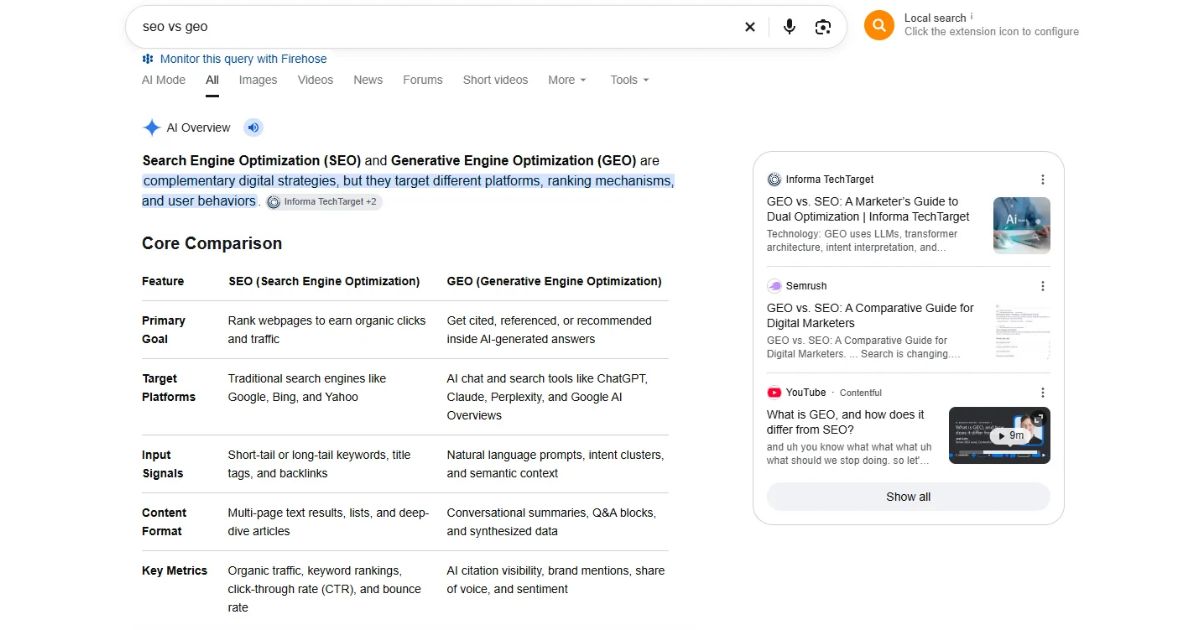
Status: results pending. This article sets out the hypothesis, the evidence so far and the test protocol. I have not run the experiment yet, so it reports no results. The results section will be completed after testing, whatever the outcome.
One of the most repeated pieces of GEO advice is simple: put a short, self-contained answer near the top of the page and AI search tools will cite you more. The advice is plausible, and some published data are consistent with it. But consistent is not proven. This article treats the advice as a question: does an answer block change whether an AI system cites a page, or do pages that have one simply tend to be better pages?
It covers what the research can and cannot say, the test I have designed, how citations will be counted and how results will be reported.
The hypothesis: does a direct answer improve citation probability?
H1: Adding a concise, accurate, self-contained direct answer near the beginning of a page increases the probability that the page is cited by AI search systems for relevant questions.
H0: Adding a direct-answer block does not produce a measurable increase in citation probability under the tested conditions.
An answer block can make a page easier for readers to scan and for software to extract without changing whether a search system retrieves or cites it. So the test keeps three outcomes apart:
| Outcome | Question | Why it is different |
|---|---|---|
| Retrieved | Did the system find and fetch the page? | Depends on indexing, ranking and the extra queries the system generates |
| Cited | Does the page appear in the final answer's sources? | A retrieved page may never be cited |
| Used | Does the answer actually rely on the page's content? | A page can be cited without supporting the claim, or used without being shown |
What existing research suggests
Two observational studies point the same way. Kevin Indig's analysis, reported by Search Engine Land, examined 18,012 verified ChatGPT citations and found 44.2% came from the first 30% of the cited page, against 31.1% from the middle and 24.7% from the last third. A Search Engine Land contributor audit of 15 domains found that 72.4% of ChatGPT-cited blog posts opened a section with a short, self-contained answer.
Both start from pages that were already cited. The audit has no comparison group of uncited posts, so it cannot say how common answer blocks are on pages that were never cited. That is the difference between “cited pages often have X” and “adding X raises the chance of citation”.
Retrieval is a separate hurdle. An AirOps study covered by Search Engine Land found that ChatGPT cited only about 15% of the 548,534 pages it retrieved, and that pages ranking first in Google were cited 3.5 times as often as pages outside the top 20. Rank and authority are strong confounders, and this is a vendor study of one platform.
The clearest live-system quasi-experiment I found tested schema, not answer blocks. Ahrefs tracked 1,885 pages that added JSON-LD against about 4,000 controls and found no clear citation gain, even though JSON-LD is about three times as common on cited pages. That is the pattern to keep in mind: common among cited pages does not mean causal.
The academic work points both ways. The original GEO paper reported visibility gains of up to 40% in its research setup, but the later C-SEO Bench found most such rewrites largely ineffective and the source's rank in the model's context more influential. A recent preprint on structural features reports a 17.3% citation-rate improvement from restructuring; I have verified only its abstract, and it is unreplicated. I could not find a randomized test of a direct-answer block on live commercial AI search. That is the gap this experiment targets.
Source-by-source verification
Evidence labels: “Read” means I opened the page and read its methodology text; “Summary only” means I read a secondary write-up rather than the original report. Figures I could not trace to a primary or near-primary source are left out.
| Source | Design and sample | Reported finding | Verification | Limits |
|---|---|---|---|---|
| GEO: Generative Engine Optimization (Nov 2023; v3 Jun 2024) | GEO-bench: 10,000 queries across 25 domains; content modifications tested in a generative-engine setup | Up to 40% higher visibility on the authors' own metric | Read (arXiv listing, paper excerpts); KDD venue not confirmed on the page I read | The methods later re-tested by C-SEO Bench (statistics, quotations, citations, fluency) do not include a direct-answer block |
| C-SEO Bench (Jun 2025; NeurIPS 2025 Datasets and Benchmarks) | 2 tasks, 6 domains, about 16.3k documents, several competing adopters | Most rewrite methods largely ineffective; the source's rank in the model's context mattered more; gains shrank as more actors adopted them | Read (abstract, excerpts) | Manipulates what the model is shown, not live web retrieval; tests rewrites, not answer-block placement |
| Lost in the Middle (Jul 2023; TACL) | Controlled position changes of the relevant passage in model input | Best performance when relevant text is at the start or end of the input; worse in the middle | Read | A plausible mechanism for position effects inside a prompt; says nothing about which pages a search system retrieves or cites |
| Search Engine Land: 44% of ChatGPT citations come from the first third (Feb 2026) | 3M ChatGPT responses, 30M citations, 18,012 verified citations matched to source text | 44.2% of citations from the first 30% of a page, 31.1% middle, 24.7% last third; cited text more often used definitions and question-style headings | Summary only; original report not read in full | Observational and conditional on a page already being cited; “top of page” is not the same as a self-contained answer block |
| Search Engine Land: content traits LLMs quote most (autumn 2025) | 15 domains, about 2M monthly organic sessions, 7,500 ChatGPT referral sessions; posts coded by hand | 72.4% of cited posts had an “answer capsule” (about 20–25 words after a question heading); about 91% of capsules had no links | Read | No comparison set of uncited posts; referral sessions miss citations without clicks; single-author coding, not peer reviewed |
| Search Engine Land: only 15% of pages retrieved by ChatGPT appear in answers (Mar 2026) | 548,534 retrieved pages across 15,000 prompts | About 15% of retrieved pages cited; Google position 1 pages cited 3.5× as often as pages outside the top 20 | Summary excerpt only | Vendor study (AirOps sells content tooling); ChatGPT only; observational |
| Ahrefs: 1,885 pages adding schema (May 2026) | Matched difference-in-differences: 1,885 pages adding JSON-LD vs about 4,000 controls; 30 days before and after | JSON-LD about 3× as common on AI-cited pages, yet adding it produced no clear gain (AI Overviews −4.6%, AI Mode +2.4%, ChatGPT +2.2%) | Read excerpts | Different intervention; every page already had 100+ AI Overview citations |
| GEO-SFE: Structural Feature Engineering (Mar 2026 preprint) | Content-structure framework tested across six generative engines | 17.3% higher citation rate and 18.5% higher subjective quality from restructuring | Abstract only; full method unverified | Unreplicated preprint; the 17.3% figure is not an answer-block result |
What the evidence supports
- Retrieval and citation are different events. Most retrieved pages are never cited, and an answer-block effect could act at either stage.
- Position and structure are associated with citation, but both observational studies start from pages that were already cited.
- Ranking and retrieval rank are strong confounders. A direct answer could be a marker of well-made pages rather than a cause.
- A plausible mechanism exists but is not proof. Whether a live search stack reproduces in-prompt position effects for web pages is the open question.
- Controlled evidence on answer blocks is thin. I found no randomized test of a direct-answer block on live commercial AI search.
- Do not generalize from one platform or one study. Most large datasets are ChatGPT-only, and several come from vendors.
The evidence ladder
| Evidence type | Example | What it can support |
|---|---|---|
| Association among already-cited pages | Indig, Gnuse audits | Answer-first text is common on cited pages |
| Large observational comparison | AirOps, Ahrefs (6M URLs) | Associations, confounded by authority and rank |
| Controlled simulation | GEO, C-SEO Bench | Whether a rewrite changes outcomes in a defined pipeline |
| Quasi-experiment on live systems | Ahrefs schema study | The nearest thing to causal evidence found; for schema it found little |
| Randomized test of an answer block on live AI search | None found | The gap this experiment targets |
Figures deliberately excluded
Several vendor blogs repeat numbers without a traceable source — for example, a claim that 55% of AI Overview citations come from the top 30% of a page, and an “answer-first pages are cited 17.3% more” line that appears to blend the GEO-SFE figure with other studies. They are not used here.
How the experiment is designed
- Sample. A pilot of 8–10 matched pairs of new pages (16–20 URLs), each answering a narrow informational question. This site's existing articles cannot serve as a test set: there are only a few, and at least one already opens with a short answer.
- Control state first. Every page is published with a same-length neutral intro. The facts are identical across pages, and the answer sits later in the body.
- Random assignment. A coin flip within each pair decides which page swaps its neutral intro for a 30–60 word self-contained answer with no links.
- Locked variables. Topic, facts, title, meta description, internal links, schema, URL, canonical, template and length stay fixed. Control pages receive a same-day no-op edit so “last modified” dates move together. Any other change is logged.
- Prompts. One neutral question per page, identical across systems, with no brand name or URL.
- Systems. ChatGPT Search, Perplexity, Gemini with search on, and Claude with web search where available. Product, mode, region and date are recorded for every test.
- Repeats. Weekly rounds with at least two runs per prompt per system: two baseline rounds, then four to six after treatment.
Design options compared
| Option | Strength | Weakness |
|---|---|---|
| Same page, before vs after | Simple | Confounded by time, indexing, competitors and model changes; not acceptable as causal evidence |
| Matched pairs, assigned by judgment | Shares time shocks across arms | Selection bias: I choose which page is treated |
| Randomized assignment within matched pairs | Removes selection bias and shares time shocks | Needs at least 6 pairs to reach p < 0.05 with an exact test; pairs still differ |
| Difference-in-differences on existing pages | Uses existing pages and adjusts for baseline | Needs many pages with citation history and a parallel-trends assumption |
| Staggered rollout across weeks | Separates the effect from calendar events | More logistics |
The randomized matched-pair pilot, step by step
- Build 8–10 pairs. Each pair answers two different narrow questions of the same intent type, difficulty and length, on the same template, so the pair never competes with itself.
- Publish every page in control state, with a fixed-length neutral intro that frames the question without answering it.
- Baseline: wait for indexing, then run two weekly rounds. If no control-state page is cited in any eligible test, stop and choose questions with a better chance of baseline citations.
- Randomize within pairs with a logged coin flip. Swap the neutral intro for a same-length direct answer; give each control page a same-day no-op edit.
- Post period: run 4–6 weekly rounds.
- Analyse as pre-registered and publish the result, including a null or mixed one.
- Optional extension: a third arm with the answer at the end of the page, to separate “has a direct answer” from “has it near the top”.
If baseline citations are zero everywhere, the fallback is questions where the site is the only source of a specific, verifiable fact, such as a measurement from its own data. Invented facts published to bait AI systems are not an option.
Treatment text, control text and locked variables
The treatment is 30–60 words of plain sentences that state the answer and its main condition, with no links, no keyword repetition and nothing the page's own evidence does not support. The 20–25 word “capsule” from the Search Engine Land audit is that author's working definition, not a proven optimum. The control is a same-length neutral intro; swapping rather than adding keeps page length constant.
Illustrative example (hypothetical, not a measured outcome): under “Why can Google Search Console impressions increase while clicks decline?”, the answer block could read: “Impressions can increase while clicks decline when a page appears for more searches but earns fewer clicks per impression, potentially because of lower average positions, different queries, or changes in the search results.”
| Variable | Rule | If it changes |
|---|---|---|
| Topic and intent | Matched within each pair | Document and consider excluding the pair |
| Facts and evidence | Identical across arms | Treat as a different page |
| Title tag, meta description, H1 | Locked after publishing | Log in the change log |
| Internal links in and out | Locked; same count per pair | Log |
| Schema | Same type on all pages, or none | Log |
| URL and canonical | Stable | Restart that pair |
| Backlinks and promotion | None to test pages; no social sharing of test URLs | Log any link found |
| Template and total length | Same template; word count within a set tolerance | Log |
Questions, prompts and systems
- One neutral question per page, written before the page is finalized, with the same wording in every system.
- No brand, domain, URL or “cite” in the prompt, and no hint at a preferred source.
- Optional paraphrases per page as a sensitivity check, analysed separately.
- Fresh session each time, personalization and memory off where possible, same region and language — all recorded.
- Each prompt repeated at least twice per system per round, weekly, because outputs and citations vary run to run.
- Planning arithmetic: tests = pages × prompts × systems × runs × rounds. For example, 16 × 1 × 3 × 2 × 6 = 576 tests.
For every test I record the product, the model or mode label shown, date and time, region, signed-in state, whether web search actually ran, and whether citations appeared inline, in a source panel or not at all. Different products do not expose the same citation information.
For an example of an article that already opens with a short answer, see why Search Console impressions rise while clicks fall.
Why not edit an old page and compare? Because indexes, rankings, competitors, demand and the AI systems themselves all change in the meantime, and a before-and-after comparison cannot separate those from the edit. A concurrent, randomized control can. If no control-state page is cited during the baseline, the pilot stops: it cannot measure an increase it has no chance to see.
What is measured and what counts as a citation
A response is eligible only if web search ran, citations were visible and the answer addressed the question. Ineligible responses are logged with a reason and reported, not hidden.
| Outcome | How it is observed | Notes |
|---|---|---|
| Retrieved or discoverable | Server logs for vendors' documented search or user-fetch agents, plus any search trace a product shows | Partial and platform-dependent; a missing log line does not prove non-retrieval |
| Cited | The target URL appears in the visible source list or inline citations | The primary metric |
| Content used | Manual check that a claim in the answer matches the target page, coded 0 or 1, with a second coder on a sample | Catches pages cited but not used |
Ineligible responses get a reason code — NO_SEARCH, NO_CITATIONS_SHOWN, ERROR_OR_REFUSAL or OFF_TOPIC — and counts are reported per platform.
A citation means the exact page URL appears in the answer's inline citations or source list. The primary metric is: citation rate = eligible responses citing the target page ÷ all eligible responses.
The effect is the difference between treated and control pages in percentage points. It is analysed per page, because repeated responses about one page are not independent observations. Secondary metrics give context:
| Metric | Why it is tracked |
|---|---|
| Domain citation rate | Shows whether other pages on the site were cited instead |
| Unique cited URLs | Measures breadth |
| Citation persistence | Shows whether a citation survives repeat runs |
| Platform differences | Prevents averaging away a platform-specific effect |
| Rankings and visibility | Context only; not a substitute for citation data |
Analysis plan
- Pre-register the primary metric, eligibility rules, assignment method and analysis before randomizing, with a timestamp.
- Difference in percentage points = (treatment rate − control rate) × 100. Arithmetic illustration only: 12 of 80 is 15.0%, 6 of 80 is 7.5%, a difference of 7.5 points.
- The unit of analysis is the page. Compute each page's rate, take each pair's difference, and bootstrap a 95% confidence interval over pairs.
- Test with an exact sign-flip randomization test. With k pairs the smallest two-sided p-value is 2 ÷ 2^k, so fewer than 6 pairs cannot reach p < 0.05; with 8 pairs the floor is about 0.008.
- Rare citations: zero citations in n independent trials gives a 95% upper bound of roughly 3 ÷ n (the rule of three); because repeats are not independent, the effective n is closer to the number of pages.
- Decide the smallest difference that matters in practice before looking at the data.
- Platform splits are exploratory and never used to rescue a null primary result.
- Inconclusive is a legitimate outcome.
How the data will be collected
Every test is logged as one row in a tests sheet, so the analysis can be reproduced and audited. The key fields:
| Field | Allowed values or meaning |
|---|---|
| arm | control or treatment (assigned arm) |
| treatment_active | Y or N at the time of the test, so baseline rounds are separable |
| web_search_status | ON, OFF or UNKNOWN |
| citations_shown | INLINE, PANEL, BOTH or NONE |
| eligible | Y or N, with an ineligible_reason when N |
| target_page_cited | 1 or 0 for the exact page |
| content_used_coded | 1, 0 or NA, coded manually |
Each row also stores the test ID, round, date and UTC time, page and pair IDs, prompt text, platform and mode, signed-in state, region, cited URL and its position in the sources, other cited URLs from the domain, saved copies of the answer and source list, and the coder.
- Pages sheet: URL, pair, assigned arm, randomization result, publish, index and treatment dates, intro and total word counts, H1, title tag, canonical, schema types, internal links in and out, and the answer-block text.
- Prompts sheet: prompt ID, page, prompt text, variant and date written.
- Change log: date, page, change description, whether it could affect the result, and who made it.
Referral visits from AI tools should be validated before they are treated as evidence; my GA4 referral traffic article covers how to check suspicious referral sources.
Results
Pending. No tests have been run.
| Page or group | Version | AI system | Eligible tests | Target-page citations | Citation rate |
|---|---|---|---|---|---|
| Pairs, control arm | Neutral intro | To be recorded | — | — | — |
| Pairs, treatment arm | Direct answer added | To be recorded | — | — | — |
Once data exist, this section will report eligible tests and citations per arm and per platform, the difference in percentage points with a 95% confidence interval, how many pages were never cited, platform splits labelled exploratory, and every change logged during the test. If citations are too rare to support a conclusion, the result will be reported as inconclusive.
Limitations and alternative explanations
- Small pilot. A handful of pages means one or two can dominate the outcome.
- New pages. Low authority means low baseline citation, which can leave too little to measure.
- Moving targets. AI products change, outputs vary between runs, and personalization can leak in.
- Matched is not identical. Randomization removes selection bias but does not make two pages equal.
- Partial visibility. Retrieval cannot be fully observed, and a page that is used but not cited leaves no trace.
- Citation is not traffic. A citation does not guarantee clicks or business value.
- Other explanations for a lift. If treated pages do better, the cause could be better indexing or snippet generation in Google or Bing rather than the AI system reading the block differently. That is why rankings are logged alongside citations.
- One site, one niche, one period. Nothing here can establish a universal ranking factor.
Checking a headline metric against real outcomes matters elsewhere too; see when Domain Rating drops but rankings do not.
What this means for SEO and GEO
Whatever the result, three points hold. A direct answer helps readers who want the answer first, whether or not it influences AI citations. It should not be treated as a proven ranking or citation factor on current evidence. And citation starts with being retrieved, which depends on crawlable, indexable, relevant pages that already rank well, so fundamentals come first.
If the test shows a lift, that supports adding accurate answer blocks to suitable pages, as one input among many. If it shows nothing, that is not a reason to strip them out. If results are mixed, the useful move is to describe which pages differed without claiming to know why.
A practical direct-answer checklist
- Pick pages that answer one specific question a real user would ask.
- Write 30–60 words that state the answer and its main condition, accurately and without hype.
- Place it directly under the H1 or the question heading, before background.
- Back it up with evidence, examples and sources further down the page.
- Use descriptive headings with one question per section.
- Check that the page is crawlable and indexable: status code, canonical, robots rules, rendering.
- Compare the page to likely queries and intent without forcing keywords.
- Track citations across several prompts and platforms over time, not from one run.
- Document every page change so a later test stays interpretable.
- Do not assume markup, a word count or a format guarantees citations. Ahrefs found no clear effect from adding JSON-LD to pages that were already cited.
Conclusion
The case for direct answers is reasonable but unproven: the strongest numbers come from pages that were already cited, and the best controlled evidence on a related tactic found little. A small, pre-registered, randomized pilot cannot settle the question, but it can show whether the effect is visible on a real site and report honestly if it is not.
If you want a measurement plan like this for your own site, my SEO and GEO services cover it.
Frequently asked questions
What is a direct-answer block?
A short paragraph, usually 20–60 words, that answers the page's main question in plain language and makes sense without the text around it. The Search Engine Land audit called a version of this an “answer capsule”.
Does adding one guarantee AI citations?
No. No tactic guarantees citations. Citation depends on whether the page is retrieved, how it compares with other sources, and how each AI product selects what to show.
Why not simply compare a page before and after the edit?
Because rankings, indexing, competitors, demand and the AI systems change over time. A concurrent, randomized control separates those effects from the edit.
Is a page that is retrieved the same as a page that is cited?
No. In the AirOps dataset only about 15% of retrieved pages were cited, and a cited page may still not support the claim it is attached to.
How many pages are needed for a reliable result?
It depends on the baseline citation rate and the size of the effect. This pilot is deliberately small. With randomization inside matched pairs, at least six pairs are needed for an exact test to be able to reach p < 0.05, and even then power may be low. A pilot should be read as preliminary.
References

Written by Muhammed Lisan A
SEO & GEO Specialist in Kerala
Muhammed Lisan A publishes practical, evidence-based research on technical SEO, crawlability, and generative engine optimization (GEO). Based in Kerala, he focuses on how modern search engines and AI answer systems discover, index, and cite content.